Running your Company

Several U.S. treaty partner jurisdictions have recently become aggressive in extending their taxation rights to cross-border acquisition transactions and the movement of assets, such as intellectual property. As a result, multinational companies should consider seeking advance unilateral or bilateral advance pricing agreements (also referred to as “APAs”) to resolve potential disagreements with foreign tax authorities and avoid lengthy and expansive audits and litigation proceedings.
What are “APAs”?
Commonly, following an acquisition of a foreign company by a U.S.-based multinational company, certain IP assets of the foreign target may need to be integrated with such company’s other operating assets to better align the ownership of IP assets with such company group’s operating structure, functions, other assets, and risks. Such an alignment of assets could involve the license, sale, or transfer of IP to the U.S. parent company or to another member of the multinational company group located in a jurisdiction different than that of the target. A cross-border transfer of assets could result in income recognition based on the value of the assets being transferred.
An APA is an agreement between a multinational company and a taxing authority or authorities regarding the transfer pricing methodology, valuation, and pricing of assets and certain transactions. A bilateral or multilateral APA (which involves the multinational company and two or several tax authorities, respectively) provides a non-adversarial alternative to resolving potential cross-border transfer pricing disputes, among many other benefits. Furthermore, the IRS is expected to be more likely to support valuation methodologies and adjustments that are based on acceptable international tax principles and valuation methodologies. The IRS’s support of a company’s valuation methodology in an APA process could be helpful in a dispute or litigation with a treaty partner jurisdiction in support of a company’s position. As a result, a bilateral or multilateral APA process provides an opportunity to set the stage and level the playing field with the treaty partner country(ies). A bilateral or multilateral APA may be a viable alternative to consider for both treaty partners (including Canada, Germany, India, Israel, Japan, Korea, Switzerland, and others) and other jurisdictions.
As a primary benefit, a bilateral or multilateral APA could eliminate the need for uncertain tax position reporting and provide for penalty protection. It would also help parties avoid repetitive tax and transfer pricing audits; limit tax authorities’ ability to change transfer prices retroactively; allow parties to manage transfer pricing real-time (rather than responding to audits years later); and mitigate the risk, cost, and burden of an audit or potentially harmful tax litigation in the U.S. and in the treaty partner jurisdiction. Other benefits may include the suspension of current tax audits or assessments relating to the transactions covered by the bilateral or multilateral APA negotiations until the APA process has been concluded, which could take several years.
For instance, recently at least one tax jurisdiction has gone so far as to argue on several occasions that the value of a target company’s IP could be higher than the entire purchase price paid to acquire such target company. The argument has been that, surely the buyer has taken into account the tax cost associated with moving the IP following the acquisition and, thus, discounted the purchase price paid for the target company and all of its assets, including its IP. Such a result, in the absence of an APA, can have a significant effect on deal structure, outcome, and consideration if not addressed in advance.
While the taxing authorities and the multinational company are not obligated to reach an agreement, they are generally required to try to reach a mutual agreement pursuant to the applicable income tax treaty, including relevant provisions for the relief from double taxation and mutual agreement procedure.
In a welcome development in the U.S., the IRS released additional guidelines on the IRS’s Advance Pricing and Mutual Agreement Program (APMA), a program that looks to identify multinational companies and matters early in the process that are more likely to successfully reach an APA resolution based on the facts at issue. Multinational companies can contact APMA for a pre-submission review and receive a preliminary opinion on whether to proceed with the APA process within just a few weeks of submitting a pre-filing memo and providing additionally requested information.
APMA considers a number of factors, including: the significance of the transaction; the probability that transfer pricing compliance will be significantly enhanced by engaging with the treaty partner; the scope, materiality, and complexity of the company group-covered transactions in the U.S.; whether there is an actual or potential transfer pricing dispute that would be most efficiently resolved through a bilateral or multilateral APA based on the APMA’s experience; country-specific strategy considerations; and the input of the treaty jurisdiction regarding the APA.
In addition to transactions involving IP assets, a bilateral or multilateral APA can cover the provision of services by a non-U.S. entity, the provision of services by a U.S. entity, sale of tangible property into and from the U.S., use of intangible property by a U.S. entity and by a non-U.S. entity, and other transactions. In the majority of “APAs”, the covered transactions involve numerous business functions and risks.
A Delaware Court of Chancery decision in Siegel v. Morse reaffirmed that courts will not entertain challenges to advance notice bylaws absent an actual, existing dispute. Even after the Delaware Supreme Court’s Kellner decision raised the bar for facial validity claims, the plaintiff attempted to reframe his challenge as an “as-applied” one, but the court found no ripe controversy since no stockholder had expressed an intent to nominate directors. The decision signals that bylaw litigation must be grounded in a real, concrete controversy and that generic concerns about defensive board behavior are insufficient without an active proxy contest or nomination dispute.
The Delaware Court of Chancery recently provided a powerful reminder of the Court’s equitable purpose, and how it will not countenance bad faith or duplicity. In Ghatty v. Mudili et al., three board members of a five-member board voted at a special board meeting to remove the remaining two directors from their officer positions, and later sued under 8 Del. C. § 225 to seek confirmation that the two directors had been validly removed from their officer roles. The Defendants challenged their removal on a number of grounds. The Court of Chancery considered one argument dispositive: that the meeting notice was inherently deficient because the meeting agenda omitted the removal action effectuated at the meeting, and indeed misleadingly suggested that one Defendant’s officer role would be expanded. The Court condemned the notice as “duplicity,” voided the vote, and held that the Defendants remained officers of the Company.
The Meeting Notice
The stated purpose of the meeting was to discuss how to bring “better governance and transparency” to the Company, and the agenda included the following items:
- Review of requests for financial statements, bank records, and supporting documentation;
- Discussion of alleged unauthorized transactions or approvals;
- Proposal for new signatory protocols and centralized finance email;
- Proposed recognition and role expansion for one of the Defendants; and
- Any additional matters raised by board members or shareholders in good faith.
Following the notice, there were additional communications amongst the directors detailing the items for discussion at the meeting. Notably, the removal of the Defendants as officers was never mentioned. In fact, although one Plaintiff director raised certain “potential areas of concern,” he specifically said that the meeting notice was not “an accusation of wrongdoing against any individual,” but was instead “a formal invitation to clarify and remedy any potential governance shortfalls,” and he invited the directors to “submit any ‘contrary evidence’ and ‘additional agenda items’ ahead of the meeting.” He also mentioned one Defendant’s “notable contributions,” and proposed that he be appointed Chief Revenue Officer and given enhanced compensation.
Before the board meeting, however, there was a “falling out” between that director and the Defendants. The latter then said that they would be unable to attend the meeting due to their “tight schedules.” The meeting went forward as planned, with only the three Plaintiff directors in attendance. Later resolutions state that, at the meeting, the three Plaintiff directors removed the Defendants as officers of the Company.
The Court found that the meeting notice technically complied with the Company’s bylaws, but nevertheless voided the vote taken at the meeting because the notice was not equitable. Instead, the Court considered it a “bait and switch that concealed the Plaintiffs’ intention to remove [the Defendants] as officers.” In holding that the Defendants remained officers of the Company, the Court stressed that “[e]quity will not abide such duplicity toward fellow directors.” The Court also rejected the argument that notice was not required where the targeted directors lacked the power to block the action, stressing that “[f]air notice fosters a genuine deliberative process – a purpose that was subverted here.”
Lessons Learned
Ghatty offers some important lessons about the value of good governance when taking board action:
- Directors are entitled to a “fair and non-misleading notice of the agenda for a special meeting,” even if the notice technically complies with the bylaws. When drafting agendas, consider whether the agenda adequately describes the discussion points and decision items for the meeting.
- Holding Regular Meetings. This meeting was the Company’s first in-person board meeting in three years. This fact was relevant to the determination of whether the meeting was a “regular” or “special” meeting. That distinction can be significant, particularly in instances where the company’s bylaws have different notice requirements for regular versus special board meetings.
- Clear Bylaws. The Court began its analysis by turning to the Company’s bylaws. In support of their argument that the meeting notice was deficient, the Defendants cited to a stockholder meeting provision in the bylaws that required a specific statement of the meeting’s purpose. Because the bylaws lacked an analog requirement for board meetings, the Court found that the notice was technically sufficient, and had to rely instead on its equitable power to reach its result. Consider whether there are unintentional gaps or inconsistencies in your company’s bylaws that can be clarified or corrected to provide more certainty and consistency across governance items. Also remember that bylaws set the rules for the game, but, as seen in Ghatty, can’t protect against bad faith.
- Records and Meeting Minutes. The Court referenced the fact that there were no contemporaneous minutes or evidence of the meeting, only a resolution dated a couple of weeks later stating that, at the meeting, “appropriate resolutions were adopted, changing certain officer and signatory roles within the Company.” Although the Court did not rely on this fact in its holding, it is a helpful reminder of the importance of appropriately and timely documenting actions taken at a meeting.
On April 29, 2026, the Delaware Supreme Court upheld the dismissal of consolidated stockholder challenges to advance notice bylaws that The AES Corporation and Owens Corning each adopted in 2023. Advance notice bylaws are the internal rules setting out how far in advance, and with what disclosures, a stockholder must tell a company it intends to nominate directors or bring business before a meeting. The stockholders attacked the provisions in the abstract, without anyone having actually attempted a nomination and been turned away.
The court held that this was not enough to proceed. Delaware courts will review these provisions when there is a concrete, live dispute about how a bylaw is being applied, not when the alleged harm depends on future events that have not occurred. The decision continues a consistent line of recent bylaw rulings and means such provisions generally will not be tested in court until a real nomination dispute arises.
On February 27, 2026, in a unanimous 37-page opinion, the Delaware Supreme Court upheld the constitutionality of significant changes to the Delaware General Corporation Law (DGCL) enacted in March 2025 via Senate Bill 21 (SB 21). This decision permits Delaware corporations and their advisers to confidently rely on these amendments for transactions with interested fiduciaries (including controlling stockholders), thereby increasing transaction planning flexibility and certainty while decreasing litigation risk under Delaware law.
Background of SB 21
As previously discussed in this Sidley Update, SB 21 provided greater statutory clarity in a number of important areas that had been the subject of common law development. It amended Section 144 to, among other things, create new statutory safe harbors for transactions with interested fiduciaries, including controlling stockholders. Although these safe harbors are akin to previously existing common law standards, they reflect important changes thereto that decrease transaction planning risk beyond those prior tests. These include (i) offering safe harbor protection in all interested-fiduciary transactions (except for going private transactions) by the use of either disinterested committee/director approval or a majority-of-the-minority vote (not both), (ii) incorporating a definition of “controlling stockholder,” and (iii) codifying standards for director independence and disinterestedness. SB 21 also amended Section 220 to clarify the scope of books and records inspections. These changes applied retroactively to all acts or transactions whether occurring before, on, or after enactment, subject only to a carveout for litigation commenced or demands made before February 17, 2025 (when SB 21 was announced). The constitutionality of the Section 144 amendments, and their retroactivity, was promptly challenged.
Constitutional Questions and Answers
In Rutledge v. Clearway Energy Group LLC, No. 248, 2025 (Del. Feb. 27, 2026), the Delaware Supreme Court considered two constitutional challenges to Section 144, focused on its safe harbor provisions and retroactive application. It rejected both.
1. First, the Delaware Supreme Court held that Section 144’s safe harbors, which preclude equitable relief and eliminate damages claims against fiduciaries, do not improperly limit the Court of Chancery’s equity jurisdiction.
Highlighting the Delaware General Assembly’s long-respected and regularly employed legislative power to amend the DGCL, including in response to common law developments, the Delaware Supreme Court held that the Court of Chancery was not improperly divested of its equitable jurisdiction via SB 21’s amendments to Section 144. The Supreme Court reasoned that the Court of Chancery remains empowered to adjudicate fiduciary duty claims and to determine whether the prerequisites for the safe harbor protections in Section 144 are achieved. Although two remedies previously available to the Court of Chancery — equitable relief and awards of monetary damages against directors, officers, controllers, or control groups — are now unavailable where the Section 144 safe harbor prerequisites have been met, the Court of Chancery retains jurisdiction over fiduciary duty claims. The Supreme Court viewed SB 21 as “a legitimate exercise of the General Assembly’s authority to enact substantive law that, in its legislative judgment, serves the interests of the citizens of our State.”
2. Second, the Delaware Supreme Court held that the retroactive application of SB 21 to transactions occurring prior to its enactment does not violate due process by eliminating vested fiduciary claims.
The Delaware Supreme Court held that SB 21’s retroactive application does not extinguish vested rights of action in a manner violative of constitutional due process rights. The Delaware Supreme Court questioned the premise that Rutledge had a vested property right prior to SB 21’s enactment because his interest was more in the form of an “anticipated continuance of” existing law. But it concluded that even assuming he had such a right, the Delaware General Assembly clearly intended that the statute apply retroactively and “exercise[d] its legislative authority in conformity with the dictates of due process” by crafting a statute reasonably related to a legitimate objective. As a result, SB 21 does not strip away vested claims in violation of due process and will apply equally to all acts and transactions on or before February 17, 2025, unless already then subject to an action, proceeding, or demand.
Key Takeaways for Boards and Dealmakers
Safe Harbor Certainty
First and foremost, Clearway preserves SB 21’s empowerment of disinterested decisionmakers to protect investors in transactions with interested fiduciaries. Corporations engaging in transactions with fiduciaries may confidently rely on the safe harbor frameworks in Section 144, which will continue to increase predictability and flexibility in corporate dealmaking while reducing litigation risk. Significantly, transaction planners can be confident that any act or transaction involving an interested director, officer, controller, or control group (other than a going private transaction) may be cleansed by either a special committee approval or by a majority-of-the-minority stockholder approval. Although Clearway settles SB 21’s constitutionality, all corporate law statutory frameworks necessarily reflect some degree of unpredictability when first enacted that will be reduced over time through case law development.
Compliance and Documentation
Parties and practitioners should take into account these amendments and design transactions to fit within Section 144’s safe harbor protections to avoid potential application of the “entire fairness” standard of review. Corporations and their counsel should continue to deploy best practices to monitor and carefully document compliance with the contours of the safe harbors. Some key areas for monitoring and documentation include:
- analysis of the disinterestedness of decisionmakers;
- disclosure of all material facts to disinterested directors;
- processes supporting a “good faith” approval of any such transaction by disinterested directors “without gross negligence”; and
- disclosure of material facts in connection with any disinterested stockholder approval of a transaction.
Reincorporation Considerations
Underpinning the Delaware Supreme Court’s constitutional analysis was a deep deference to the Delaware General Assembly’s ability to amend (often swiftly) Delaware’s corporate law statutes. The decision therefore bolsters one of the reasons many corporations have chosen to incorporate in Delaware: a fast-acting and responsive legislative branch. The substance of SB 21 is likewise an important consideration in any reincorporation discussion, because the Section 144 amendments provide a roadmap for transaction planners to follow that reduces unpredictability and overall litigation risk, although we anticipate that litigation challenges will be brought to develop the contours of the statute’s application.
Delaware has long been the default jurisdiction of incorporation of high-growth emerging companies due to its advanced, and evolving, body of corporate law, a specialized Court of Chancery, and decades of corporate law cases and precedents. But that default assumption has now come into question.
In recent years, Delaware’s courts have issued a series of decisions that have left some founders of high-growth companies unsettled. See, for instance, the recent Tesla cases, following which Elon Musk publicly blasted Delaware and both Tesla and SpaceX reincorporated in Texas. Musk is not alone in this trend toward “DExit” – TripAdvisor, Dropbox, AMC Networks, and Roblox are among those reincorporating in Nevada, and Dillard’s joined Tesla and SpaceX by reincorporating in Texas. Even Meta publicly announced that it was exploring a move out of Delaware in 2025.
In response, Delaware’s legislature adopted major reforms in 2024 and early 2025 (SB 313 and SB 21) codifying safe harbors for conflicted transactions, narrowing books-and-records access, and strengthening management’s shield against litigation.
More and more founders and GCs of later-stage companies are now wondering if Delaware should still be the default.
So, should you care and, if so, where are companies moving?
“Y’all Street” as an Alternative?
In recent years, Texas lawmakers have aggressively reformed state law to attract corporations. The state’s pitch? A pro-business legal climate, big-market economy, and fewer stockholder hassles. In 2024, Texas launched a new statewide Business Court system modeled on Delaware’s Chancery Court, with specialized judges to handle complex corporate cases. This was quickly followed in May 2025 with sweeping legislated changes (SB 29) to the Texas Business Organizations Code, in a package branded as “Texas: Open for Business." Key provisions include:
Codification of the Business Judgment Rule:
Texas now explicitly codifies the business judgment rule and the high bar to rebut it, giving directors stronger protection when their decisions are challenged.
Limits on Derivative Lawsuits:
Allowing corporations to set a minimum ownership threshold (up to 3%) for stockholder-plaintiffs to bring a derivative suit. This threshold is higher than most states and drastically curbs the ability of small stockholders to sue on behalf of the corporation.
Records and Litigation Procedure:
Limiting what constitutes corporate “books and records” available for stockholder inspection. For instance, emails and electronic communications are excluded. It also allows companies to include provisions in their charters or bylaws waiving the right to jury trials in corporate disputes, meaning cases would be heard solely by judges (as they are in Delaware’s Chancery Court).
In addition to the changes effected by SB 29, Texas later enacted several additional measures to allow certain Texas-listed public companies to adopt higher thresholds for stockholder proposals and to authorize the board of directors to delegate more discretion to the corporation’s executives.
Pros and Cons of the Y’all Street
The Texas proposals seem very attractive, especially to issuers and their insiders, but, in practice, their effectiveness is hard to measure. The new courts lack Delaware’s decades of precedent, making Texas less predictable for companies. So, certainty with respect to a few specific matters is offset by uncertainty with respect to treatment of a myriad of others. Additionally, incorporating in Texas might expose a corporation to Texas venue for certain lawsuits.
Texas has certainly had some luck in attracting private and public companies as of late, and we are working with a number of companies exploring Texas as a potential alternative to Delaware.
The “Silver Sanctuary”?
Like Texas, Nevada’s appeal lies in providing certainty to companies and their insiders with respect to certain specific common transactions. It automatically offers directors and officers strong protections. Key features of Nevada’s corporate environment include:
Robust Liability Shields
Nevada law automatically exculpates directors and officers from personal liability for breaches of fiduciary duty (except in cases of intentional misconduct, fraud, or knowing law violations). In Delaware, by contrast, corporations must opt in to exculpation (and even then, it covers only duty of care, not loyalty, and only recently were officers allowed similar protection). Nevada’s default rule thus gives executives peace of mind that honest mistakes won’t easily lead to personal liability. Likewise, Nevada statutes make it easier to indemnify and protect managers, which can reduce D&O insurance costs.
Consideration of Other Interests
Nevada explicitly permits boards to consider long-term corporate interests and the impacts on employees, customers, the community, etc., when making decisions. Directors are not strictly bound to maximize immediate stockholder value at all costs. This allows directors to justify decisions that favor sustainable growth or other constituencies, without breaching their duty to stockholders. This contrasts with states like Texas or Delaware, where directors must generally act in the best interests of the corporation and its stockholders, with true stakeholder balancing available only if the corporation opts into a Public Benefit Corporation framework.
No Franchise Tax
From a financial perspective, Nevada imposes no corporate franchise tax and so may prove cheaper to operate in, especially for early-stage companies.
Pros and Cons of the Silver Sanctuary
Nevada offers what Nevada usually offers: more freedom to operate at the expense of less predictability. Nevada’s business courts were established in 2001, but those courts have not published nearly as many written opinions, or as routinely, as Delaware’s Court of Chancery. The law, while more insider-friendly, is also less modernized in other areas.
So, in the end, what should you do?
The answer is not clear-cut. For now, there is no mass flight out of Delaware, but certainly lots of discussions are taking place. No clear winner has emerged for the alternatives, but it does appear that more public companies are leaning towards Texas while more private companies are considering Nevada. But the vast majority of new incorporations are still taking place in Delaware.
It all comes down to perception, expectation, and, perhaps in the future, actual experience. To help your thinking, a chart summarizing some, but certainly not all, of the key features of the three regimes may be found here:
In more challenged private company financing environments, down rounds (i.e., an equity financing at a lower valuation than a prior equity financing) often go from a relatively uncommon occurrence to a more common aspect of many growth equity and venture capital financings. The interrelated impact of geopolitical and macroeconomic events such as valuation resets from post-pandemic highs, public and private market liquidity constraints, prolonged fundraising cycles, and shifts in bargaining power can have profound effects on growth equity and venture capital financing dynamics, making down rounds and valuation pressure more common. Down rounds have significant implications for all participants in the venture ecosystem: founders and management teams, investors, employees, and fund limited partners.
This article focuses on the basic mechanics of conversion price-based anti-dilution protections for convertible preferred stock. Anti-dilution protections need to be considered in the context of the impact on the pricing of the down round in question, and also on the potential impact of future adjustments.
Anti-Dilution Protections
In any equity financing, two types of dilution can occur when a company issues new shares: (1) percentage dilution occurs because the issuance increases the number of outstanding and fully-diluted shares, reducing an existing holder’s ownership percentage if that holder does not maintain their ownership percentage through additional investment, and (2) economic (or price) dilution occurs when a company issues shares at a price that is lower than the conversion price applicable to an investor’s shares, reducing the value of that investor’s position on an as-converted basis.
The conversion price-based anti-dilution protections discussed below are intended to mitigate economic (or price) dilution and the resulting percentage dilution on an as-converted basis. Investors may also help protect against percentage dilution through preemptive rights, which can permit pro rata participation in later financings, whether those are up rounds or down rounds.
Below is a simple illustration of how dilution can occur:
- Before a down round, if Investor A purchased 2,500,000 shares of convertible preferred stock at a price of US$5 per share, and after that financing there were 10,000,000 shares of the company outstanding, Investor A’s US$12,500,000 investment would represent a 25% ownership stake in the company.
- In the down round, the company sells 5,000,000 new shares to investors (other than Investor A) at a price of US$4 per share.
- Following the down round, Investor A continues to own 2,500,000 shares of convertible preferred stock, now out of 15,000,000 outstanding shares of the company, representing a decreased ownership stake in the company of 16.67%, valued at approximately US$10,000,000.
To help protect against the scenario above, Investor A would typically have negotiated for price-based anti-dilution protection when it originally purchased its convertible preferred shares. In a down round, these protections operate to adjust Investor A’s conversion price and therefore the rate at which those shares ultimately convert into common stock. There are two main types of conversion price-based anti-dilution protection: (i) full ratchet and (ii) weighted average.
Full Ratchet
While less common in practice, there has been an increased use of full-ratchet anti-dilution protections to bridge valuation gaps (sometimes, with a sunset date). When used, they can have a profound impact on down-round financing. With full ratchet anti-dilution protection, the conversion price applicable to Investor A’s convertible preferred shares is reset to the new lower price per share from the down round (which is US$4 in the example above), meaning each preferred share from then on would convert into 1.25 shares of common stock.
Now, as a result, if those preferred shares convert, Investor A would own 3,125,000 shares of common stock out of 15,625,000 outstanding shares, meaning Investor A would therefore have a 20% ownership stake (which is less than Investor A’s initial 25% stake, but greater than the 16.67% stake Investor A would have been left with without this full ratchet protection).
Full ratchet protection is not common, but when it does exist, the resulting impact in a down-round financing can be profound.
Weighted Average
Weighted-average anti-dilution protection is far more customary. With weighted-average anti-dilution protection, a formula is used to determine a new conversion price that will apply to existing preferred shares following a down round:
- New Conversion Price = Old Conversion Price * [(X + Y) / (X + Z)]
- X = the number of shares outstanding on a fully-diluted basis before the down round.
- Note that the nuances of the X variable are sometimes negotiated, with a company preferring a broader approach (often referred to as the “broad-based” weighted-average formula) that includes all shares on a fully diluted basis, and an investor preferring a narrower approach (often referred to as the “narrow-based” weighted-average formula) that excludes certain types of derivative shares such as options and warrants. The broad-based weighted-average formula is more commonly used.
- Y = the number of shares that would have been issued to new investors in the down round had the full investment been made at the old price per share (which is US$5 in our example above).
- Z = the number of shares issued to new investors in the down round at the new price per share (US$4 in our example).
- X = the number of shares outstanding on a fully-diluted basis before the down round.
In our example, the resulting math would be:
New Conversion Price = US$5.00 * [(10,000,000 + 4,000,000) / (10,000,000 + 5,000,000)]
- US$5.00 * [(14,000,000) / (15,000,000)]
- US$5.00 * [0.933]
- US$4.67
Under this approach, the adjusted conversion price applicable to Investor A’s convertible preferred shares is now US$4.67, meaning each of Investor A’s preferred shares is convertible into 1.07 shares of common stock.
Now, if those preferred shares convert, Investor A would own 2,675,000 common shares out of 15,175,000 outstanding shares, meaning Investor A would therefore have a 17.63% ownership stake (which is less than Investor A’s initial 25% stake, and less than the 20% stake Investor A would have had with full-ratchet protection, but more than the 16.67% stake that would have resulted without any protection).
Economic Dilution
As mentioned above, conversion price-based anti-dilution protections are designed to reduce the impact of percentage dilution, but they also mitigate economic dilution. Continuing with our example:
- Before the down round, the value of Investor A’s as-converted stake in the company was US$12,500,000.
- Value = (Price Per Share * Number of As-Converted Shares)
- (US$5.00 * 2,500,000)
- US$12,500,000
- Value = (Price Per Share * Number of As-Converted Shares)
- Without any anti-dilution protection, the value of Investor A’s as-converted stake in the company would drop to US$10,000,000.
- Value = (Price Per Share * Number of As-Converted Shares)
- (US$4.00 * 2,500,000)
- US$10,000,000
- Value = (Price Per Share * Number of As-Converted Shares)
- With full-ratchet anti-dilution protection, the value of Investor A’s as-converted stake in the company would remain US$12,500,000.
- Value = (Price Per Share * Number of As-Converted Shares)
- (US$4.00 * 3,125,000)
- US$12,500,000
- Value = (Price Per Share * Number of As-Converted Shares)
- With weighted-average anti-dilution protection, the value of Investor A’s as-converted stake in the company would drop to US$10,700,000 instead of US$10,000,000.
- Value = (Price Per Share * Number of As-Converted Shares)
- (US$4.00 * 2,675,000)
- US$10,700,000
- Value = (Price Per Share * Number of As-Converted Shares)
Down Round Pricing Must Be Modeled Holistically
These anti-dilution mechanics may be familiar to and understood by most management teams, investors, and advisors, but the practical implications are often not as straightforward. In practice, the negotiated enterprise value, or pre-money valuation, of a company is typically set at the outset of a negotiation, but the resulting per-share price often is not. The per-share price must generally be solved for after giving effect to anti-dilution adjustments, any option pool increase, and the resulting post-closing capitalization. When solving for this price per share, if anti-dilution adjustments would be triggered, the result is that the end-result number of as-converted shares outstanding will be higher than otherwise, which can prompt an iterative calculation. The end-result number of as-converted shares outstanding, and therefore the preferred price per share, must be solved for again.
Existing investors’ anti-dilution protections typically create a direct economic tension with the investors proposing to lead the down-round financing. This is because new investors typically bargain for a specified ownership percentage and expect their investment to buy it. Existing investors may seek to maximize the value of their anti-dilution adjustments. Common stockholders and other unprotected holders, including management and employee option holders, end up bearing much of the resulting dilution and often are most heavily “crammed down.” On the other hand, existing and new investors typically want to ensure that the management team is protected and appropriately motivated, so the option pool increases, the number of end-result fully diluted shares outstanding again changes, and the entire iterative calculation dance begins again. Add in the fact that many down rounds are led by some subset of existing investors, and the tension around the per-share price calculations increases further.
Because of these dynamics, down-round pricing should not be modeled by simply picking a per-share price. Instead, the agreed pre-money valuation, anti-dilution adjustments, option pool increase, and post-closing ownership targets should be modeled together and holistically to ensure that the intended transaction is delivered.
Discussions over a down-round transaction often expand well beyond pricing mechanics and can raise questions about participation, including the potential emergence of a pay-to-play dynamic, board fiduciary duties, voting power, minority equityholder protections, contingency planning for future financing, potential waivers of anti-dilution protections, control-investor risks, the consent process, and the consensus-building required to secure key approvals.
One of the most common legal missteps among emerging companies involves the classification of the people doing the work. In the earliest days of a startup, founders often bring on talented individuals as “consultants” or “independent contractors,” compensating them primarily or exclusively with equity. This arrangement feels natural when cash is scarce and everyone is pitching in to build something from the ground up. But what begins as a practical solution can quickly become a significant legal liability if the company does not revisit these classifications as it matures and secures funding.
This article provides a high-level overview of the risks associated with worker misclassification, the key legal frameworks that govern these determinations, and the steps founders should take to clean up classification issues before they become costly problems.
The Common Pattern: Early “Consultants” Who Are Really Employees
It is extremely common for pre-revenue startups to engage early team members as independent contractors or consultants. The logic is straightforward: The company cannot yet afford salaries, payroll taxes, or benefits, so it issues equity in exchange for labor. On paper, the individual signs a consulting agreement, invoices the company (or doesn’t), and is treated as a 1099 worker for tax purposes.
The problem is that many of these individuals are, as a matter of law, employees regardless of what the agreement says. Classification is not a matter of mutual agreement between the parties. It is determined by the nature of the working relationship under applicable federal and state law. If the engagement looks and feels like employment, then government agencies and courts are likely to treat it as such.
When these individuals are never reclassified, the company accumulates exposure over time. That exposure includes unpaid wages, overtime, employment taxes, penalties, and potential liability under both federal and state law. These issues often surface at the worst possible moment: during due diligence for a funding round, an acquisition, or in response to a complaint filed by a disgruntled former worker.
Why Reclassification Should Be a Priority After Funding
Securing any meaningful financing event should serve as a trigger for the company to revisit every worker classification. There are several reasons for this.
First, the original justification for the consulting arrangement, namely the inability to pay cash compensation, has likely changed. Once the company has capital, it has the resources to bring workers onto payroll and provide the protections required by law. Continuing to classify a worker as an independent contractor when the company now has the means to pay wages and withhold taxes weakens any argument that the arrangement was legitimate.
Second, investors and their counsel will scrutinize the company’s employment practices during due diligence. Misclassification issues are a well-known red flag. Unresolved classification problems can delay or even derail a financing, reduce the company’s valuation, or result in specific indemnification obligations imposed on the founders.
Third, as the company grows, the risks multiply. More workers mean more potential claimants. Longer periods of misclassification mean larger back-pay and tax liabilities. And the shift from a small, informal team to a structured organization makes it increasingly difficult to argue that any given worker was genuinely operating as an independent business.
The bottom line is that reclassification is not merely a housekeeping exercise. It is a critical step in putting the company on sound legal footing for its next phase of growth.
Federal Law: The Key Frameworks
At the federal level, worker classification is governed by several overlapping tests, depending on the statute at issue.
The Fair Labor Standards Act
The FLSA uses an “economic reality” test to determine whether a worker is an employee or an independent contractor. The inquiry focuses on whether the worker is economically dependent on the company or is in business for themselves. Factors include the degree of control the company exercises over the work, the worker’s opportunity for profit or loss, the worker’s investment in equipment or materials, the permanence of the relationship, the degree of skill required, and the extent to which the work is an integral part of the company’s business. The Department of Labor has historically taken a broad view of employment under this test, and the consequences of misclassification include liability for unpaid minimum wages and overtime, liquidated damages, and attorneys’ fees.
The Internal Revenue Code
The IRS applies a common-law test that examines the degree of control and independence in the relationship. The IRS groups relevant factors into three categories: behavioral control (whether the company directs how the work is done), financial control (whether the company controls the business aspects of the worker’s role, such as how the worker is paid and whether expenses are reimbursed), and the type of relationship (including written contracts, benefits, and the permanence of the engagement). Misclassification under the tax code can result in liability for unpaid employment taxes, penalties, and interest. In some cases, officers of the company may face personal liability under the trust fund recovery penalty.
Exempt vs. Non-Exempt Classification
Once a worker is properly classified as an employee, the company must also determine whether the employee is exempt or non-exempt under the FLSA. Exempt employees are not entitled to overtime pay, but they must meet specific salary and duties tests. The most commonly applicable exemptions for startups are the executive, administrative, professional, and computer employee exemptions. Each requires that the employee be paid on a salary basis at or above a specified threshold and that the employee’s primary duties satisfy specific criteria. Founders should not assume that simply paying a salary or giving someone a managerial title is sufficient. The analysis turns on the actual duties performed, not the job title.
State Law: Where the Rules Get Stricter
Many states impose classification standards that are more restrictive than federal law, and compliance with federal standards alone does not guarantee compliance at the state level.
California’s ABC Test
California applies a particularly stringent standard under its ABC test, codified by Assembly Bill 5. Under this test, a worker is presumed to be an employee unless the hiring entity demonstrates that the worker (A) is free from the company’s control and direction in performing the work, (B) performs work that is outside the usual course of the company’s business, and (C) is customarily engaged in an independently established trade, occupation, or business of the same nature as the work performed. Prong B is often the most difficult to satisfy for startups, because early workers are typically performing tasks that are central to the company’s core business. California law also provides for significant penalties for misclassification, including penalties under the Private Attorneys General Act, which allows employees to bring representative actions on behalf of the state.
Other Notable State Frameworks
Several other states have adopted or are moving toward ABC-style tests, including Massachusetts, New Jersey, and Illinois. New York applies a similar multi-factor test and has aggressive enforcement mechanisms. States vary considerably in their approaches, and companies with remote workers in multiple states must ensure compliance in each jurisdiction where a worker is located, not merely where the company is headquartered. Founders should be particularly attentive to any state in which the company has workers, as the applicable test is generally determined by the worker’s location.
Cleaning Up Past Misclassification
For companies that have already been operating with misclassified workers, there are several steps to consider when undertaking a remediation effort.
The first step is to conduct an honest internal audit. Identify every individual who has been engaged as a contractor or consultant and evaluate each engagement under the applicable federal and state tests. Determine which individuals are likely misclassified and assess the duration and scope of the exposure.
The second step is to consult with experienced employment counsel. Remediation strategies vary depending on the jurisdiction, the number of affected workers, the duration of misclassification, and the company’s financial position. In some cases, the IRS Voluntary Classification Settlement Program may be available, which allows companies to prospectively reclassify workers with limited look-back liability in exchange for a modest payment. Similar programs or settlement frameworks may exist at the state level.
The third step is to transition misclassified workers to employee status going forward. This includes placing them on payroll, withholding applicable taxes, providing required benefits, and ensuring compliance with wage and hour laws, including proper exempt or non-exempt classification.
The fourth step is to address the equity arrangements already in place. Early equity grants made to individuals who should have been classified as employees may have been structured as contractor grants, which have different tax treatment than employee equity awards. Companies should work with both employment counsel and tax advisors to evaluate whether corrective filings or revised equity documentation are necessary, particularly with respect to Section 409A of the Internal Revenue Code, which governs deferred compensation and imposes significant penalties for noncompliance.
Finally, companies should implement classification policies and procedures that will prevent these issues from recurring as the company continues to hire. A brief intake process for every new engagement, whether employee or contractor, can go a long way toward ensuring that the correct classification is applied from the outset.
For private companies backed by venture capital investors, acquisition is frequently the most likely path to liquidity. Founders are often laser-focused on product development, market expansion, and fundraising, without devoting the same early-stage discipline to ensuring the company is well-positioned for a future exit via a merger or acquisition.
M&A preparedness is not a late-stage exercise, but an operational strategy to position your company as an attractive, high-value target to potential acquirors.
Corporate Governance
Some of the most common obstacles to efficient M&A processes stem from issues related to corporate governance. Complex capitalization tables, unclear chain of equity ownership, and unresolved governance issues can create transaction delay and, depending on the structure of the transaction, loss of leverage.
Companies should consider focusing on three key areas of corporate governance to be prepared for future M&A processes: capitalization table discipline, stockholder rights, and board and stockholder alignment.
Capitalization Table Discipline
Maintain clear documentation of all equity issuances with proper board and stockholder approvals; confirm board minutes are complete, approved by the board, and signed; verify that 83(b) elections have been timely filed with respect to restricted stock grants to founders and early employees; and ensure 409A valuations are updated following major events that may impact valuation (such as a financing) and, absent such events, at least annually.
Stockholder Rights
Ensure all stockholders have signed the relevant stockholder agreements and that the company’s management team understands the protective provisions embedded within such agreements; similarly, ensure that the company’s management team is familiar with relevant provisions of any investor side-letters (think drag-along mechanics, rights of first refusal, and co-sale rights).
Board and Stockholder Alignment
Understand what approvals are required to approve a sale or merger of the company and whether any investor has blocking rights.
Contracting Discipline
Material contracts, such as key vendor and customer agreements, collaboration agreements, and licensing arrangements, are some of the first diligence requests in an M&A process. These contracts often contain assignment or change-of-control provisions that can require third-party consent, accelerate payment obligations, or trigger termination rights or other contractual rights that could significantly impact the trajectory of a deal. Accordingly, it is important for companies to maintain clear records of all material contracts, ensuring that all contracts are fully executed and include all attachments, exhibits, amendments, and restatements. Companies should track whether any material contracts have upcoming renewals or expiration dates. Additionally, tracking key provisions in such material contracts that may be triggered by an M&A (such as third-party consent requirements) will help streamline the M&A diligence and consent process.
Intellectual property is another value-driver for life sciences companies and technology companies, making it vital for companies to have documentation that clearly delineates intellectual property ownership. Companies should verify that all employees and contractors have signed Proprietary Information and Inventions Assignment Agreements (PIIAAs), review consulting agreements to confirm that intellectual property created by consultants/contractors has been validly assigned to the company, and obtain confirmatory assignments from founders and early contributors, if needed, and at the appropriate time. For companies with affiliated entities, confirm that the company’s core intellectual property assets sit within the target entity and not within any affiliated entities.
Being proactive can save time and expense during the M&A diligence process.
Regulatory Compliance
Depending on industry and geography, regulatory risk can become a gating diligence issue. Companies should identify areas of risk and preemptively resolve any outstanding compliance risks (e.g., data integrity, marketing, industry-specific licensing, etc.). In particular, life sciences companies should consider pursuing regulatory planning with the assistance of healthcare and/or FDA counsel (as needed) to ensure, among other things, that regulatory filings, communications, and approvals are complete and accessible.
Deal Team Preparation
Once the company has decided to start a sale process, identify at the outset who will be part of the core deal team, which will typically consist of a select number of employees and outside advisors. Members of executive management and other key internal personnel with specialized knowledge about the company’s corporate governance, labor and employment practices, employee benefits structure, assets (IP, real estate, etc.), litigation exposure, and regulatory compliance are typically included within the core deal team. Further, at the appropriate time, companies should engage outside advisors, such as outside legal counsel, financial/tax advisors, and investment bankers, all of whom can help quarterback the transaction and efficiently drive the deal process.
After the deal team is in place, consider implementing deal confidentiality procedures to maintain the integrity of the sale process:
- assign code names to the project and company participants;
- limit working group size and access; and
- consider antitrust issues and the use of “clean team” agreements and data rooms.
Data Room Readiness
Prepared companies treat diligence readiness as an ongoing process and not an exercise triggered by a letter of intent or term sheet. First, select a virtual data room that provides strong security and activity tracking. Second, build the company’s data room with organizational discipline, using logical folder structures (corporate, IP, finance, regulatory, benefits, etc.) and uploading documents in a searchable, digital format with consistent document naming conventions. Lastly, in connection with building the data room, flag with the guidance of deal counsel any confidentiality concerns and access restrictions that need to be put in place. For example, are there any documents that need to be redacted or anonymized? Does the transaction present antitrust sensitivity requiring documents to be shared through a “clean room”?
In all, a well-maintained and categorically organized data room significantly accelerates a sale process and signals sophistication to potential acquirors.
The most successful exits rarely begin when a banker is engaged. Ideally, they begin years earlier with strategic and operational foresight. Companies that understand the value of M&A preparedness can preserve negotiation leverage and act more decisively when M&A opportunities arise. After all, engineering an exit is more than closing a deal — it is positioning the company so that the right deal finds you.
Whether a company is gearing up for an acquisition, a growth equity financing, or an IPO, a due diligence review will be an inevitable part of that transaction, and that review will test not only the current business but also the integrity of a company’s historical records. Readiness for that review is critical, as once a diligence process begins, gaps in corporate approvals, equity records, contract management, intellectual property ownership, and regulatory compliance can quickly become leverage for purchase price adjustments, closing conditions, and/or special indemnities. At best, diligence gaps can consume management attention at a time when a company has little bandwidth to spare. At worst, they can detract from a company’s credibility and can have a meaningful impact on deal speed and certainty. Most issues are fixable, but the available solutions often narrow after a deal is already on the table. This article provides an overview of actionable steps leadership at mid- to late-stage private companies can take to make transaction readiness an ongoing discipline rather than a pre-signing scramble.
Set Up and Maintain a Virtual Data Room
Rather than waiting until a letter of intent is signed, companies should stand up and maintain a virtual data room (VDR) early, using records they already keep locally, and treat it as a living repository of critical corporate documents. Management teams that prepare to address anticipated diligence focus areas and maintain organized virtual records early are better positioned when a process launches than teams that start flat-footed. Companies can get a head start by asking outside counsel for a standard due diligence request list, which serves as an organizational and gap-identification tool, as well as an organized table of contents for their VDR. This ensures that documents are comprehensive and indexed by categories prospective investors and acquirers will expect.
The VDR should contain current, fully executed, and dated documents together with all amendments, statements of work, and side letters. Superseded and terminated agreements should be archived, not deleted or mixed with operative versions. One small but time-saving step in setting up a VDR is using a consistent and intuitive naming convention as documents are uploaded, which will help not only management but also third-party reviewers quickly navigate the VDR’s contents. Once a diligence process begins, access should be staged and subject to tiered permissions, with additional controls for competitively sensitive information, compensation data, and litigation files; privileged materials should be withheld or handled through a process designed to preserve privilege. Particularly when a potential buyer is a competitor, or when the underlying material is subject to confidentiality restrictions that do not permit sharing with a potential acquirer or investor, counsel should advise prior to upload and contemplate redactions, clean-team arrangements, and restrictions on downloading or printing. When in doubt, leave it out; it is easier to pause early and evaluate permissions and other protections than to pull back a document after it has been shared.
A word of caution: prospective investors now run AI review tools that can scan an entire data room in minutes, and while that process can generate false positives, it can also magnify every internal inconsistency across the VDR, including in the cap table, contracts, and other materials. As a best practice, keeping the VDR updated quarterly helps identify issues early and positions the company and management to earn credibility from the moment that transaction diligence begins.
Maintain a Corporate Record Book and Organizational Documents
M&A buyers and growth equity investors will expect clean and current corporate governance records. This means prospective investors will review: current versions of the certificate of incorporation (including all amendments) and bylaws; board and stockholder minutes; and fully executed, dated written consents. An improperly compiled consent with a missing signature page or date can cost the company meaningful time and resources to track down or, worse, require corrective action to cure. Every material corporate action should tie out to a corresponding board and/or stockholder approval, including equity issuances, option grants, director and officer elections, and subsidiary formations.
Companies should also at least annually confirm good standing in their state of incorporation and in every jurisdiction in which they are qualified to do business. Outside counsel can obtain verbal good standing confirmations from third-party service providers, often for a nominal or no cost to the company. Good standing lapses can trigger fees, taxes, and penalties and, in many states, can bar the company from bringing suit in local courts until the lapse is cured, although a lapse does not typically invalidate contracts executed while the company was not in good standing. For an additional layer of caution, companies can consider ordering lien and litigation searches from third-party service providers in the same set of jurisdictions.
Ensure Vigilant Capitalization Table Hygiene
The company should expect buyers or investors to request a current copy of the capitalization table and, in the case of an equity financing, a pro forma cap table reflecting the completed round. Most cap table hygiene issues exist well before a contemplated transaction and surface in the diligence process. Common hiccups include unsigned option grants, undocumented stock issuances, unrecorded convertible note draws, and inconsistencies between vesting schedules and employment terms. Cap table accuracy is key: a company’s representations about its capitalization are often treated as fundamental representations, giving buyers or investors the ability to claim breach even for minor discrepancies. Moreover, a messy cap table can be perceived as poor ownership discipline by the company or its management.
With assistance from outside counsel, the company should reconcile the cap table against the stock ledger and equity grant documentation, ensuring that every stock and option issuance is supported by board resolutions, grant agreements, evidence of payment of the exercise or purchase price, and, if applicable, an approved, unexpired equity incentive plan. Each option grant should also be supported by a current 409A valuation that supports the board’s determination of the fair market value of the underlying shares.
Importantly, companies should develop a clear understanding of how antidilution provisions operate and how change-of-control acceleration clauses (single-trigger and double-trigger) may affect the equity/distribution waterfall in a transaction. Modeling these scenarios in advance allows management to communicate the deal economics clearly to all stockholders and avoids last-minute surprises that can derail negotiations.
Understand Key Provisions in Material Contracts
Counsel for buyers and investors will expect the opportunity to review each contract that is material to the business. These typically include: contracts with key customers and suppliers above certain revenue or expense thresholds; license agreements; leases; employment and severance agreements with key personnel; and other contracts that are important to the business. These contracts often contain change-of-control consent triggers, rights of first refusal, out-licensing restrictions, most favored nation provisions, exclusivity, non-solicit, non-compete, and other restrictive covenants. In certain circumstances, a counterparty may have a notice, consent, or termination right in connection with a transaction. Accordingly, with the help of outside counsel, a company should be generally aware of which key agreements contain those provisions and should have a plan for obtaining consents or providing timely notice in advance of entering into a transaction process. Seeking consent late in the process can give leverage to the counterparty, which can increase overall costs and decrease deal certainty.
Confirm Intellectual Property Ownership and Assignment of IP
Depending on the company’s core business, clean IP title is often a significant driver of the diligence process. One consideration that comes up time and again is whether every founder, employee, and contractor who contributed to the company’s IP portfolio has executed an invention assignment agreement that assigns all intellectual property rights to the company. It isn’t uncommon for advisors and early contributors in early-stage companies, often compensated in equity, to miss the assignment paperwork altogether, or to execute, but not date, the assignment. Any gaps in assignment should be addressed ahead of the buyer or investor diligence process, which can be done with the help of outside IP counsel. Companies should also routinely conduct an audit of open-source software usage to confirm compliance with applicable license terms.
Maintain Compliance with Industry-Specific Regulatory Requirements
Companies operating in regulated industries, such as healthcare, financial services, energy, and government contracting, should confirm that all material licenses, permits, and registrations are current and in good standing. Identifying regulatory approvals or notices that would be required in connection with a change-of-control or assignment of a license can avoid an additional layer of investor diligence caused when gaps are identified later in the deal negotiation process. Regulatory non-compliance discovered during diligence can significantly delay closing or reduce deal certainty.
Not every liquidity transaction is a “Tender Offer.” Many private company secondary transactions are one-off, individually negotiated sales of shares by a founder, employee, or early investor to a new or existing investor. These transactions avoid much of the regulatory apparatus discussed in our companion article on Tender Offers, but they are far from unregulated and raise their own legal, tax, and practical considerations for the seller, the buyer, and the company.
Secondary Sales vs. Tender Offers
If a secondary transaction does not meet the definition of a “Tender Offer” (a determination made under the Wellman test discussed in another Catalyst article), the Tender Offer rules – including those mandating minimum disclosures, a minimum offering period, withdrawal rights, and others – will not apply. Instead, the terms of each transaction are negotiated between the buyer and the seller, with the company sitting in the middle as the party whose consent is needed and whose stock records must reflect the transfer.
Documentation and Settlement Mechanics
Secondary sales are typically documented in a secondary stock purchase agreement negotiated between the buyer and the seller. Although such agreements typically follow a similar format, they are usually tailored to the transaction at hand, addressing sale mechanics, representations and warranties, waivers and disclaimers, and any additional rights, and they typically feature company consent, the waiver or expiration of rights of first refusal and co-sale rights, and the allocation of transfer costs and taxes.
Settlement mechanics deserve more attention than they often receive. Because private company shares are not held through a clearing system, closing is a coordinated exercise among the buyer, the seller, and the company (or its cap table administrator), and it can get complicated if the seller must first exercise stock options or convert other securities. In that case, the mechanics must often provide an advance of the exercise price to the seller (whether by the buyer or the company), the company’s processing of the exercise, and the calculation and processing of any associated tax withholdings. The agreement should spell out the sequence of events and the responsibilities of each party clearly; note also that option exercises may take several days to process, so the timeline should be clear and precise.
Securities Law Considerations
Exemption from Registration
As these are still transactions in private company stock, they must be conducted in reliance on a valid exemption from the registration requirements of Section 5 of the Securities Act of 1933 (the “Securities Act”). Because the seller is not the issuer, the question is whether the seller can resell its shares without being deemed an “underwriter.” Two approaches have become the most common over the years:
- The “Section 4(a)(1½)” exemption: Historically the most commonly used exemption, especially prior to the introduction of Section 4(a)(7), this is a product of practice and case law rather than statute. The idea is that a resale by a non-issuer should be exempt under Section 4(a)(1) (which exempts transactions by persons other than issuers, underwriters, and dealers) so long as it is conducted in the manner required of an issuer’s private placement under Section 4(a)(2): generally, a sale to a limited number of sophisticated or accredited purchasers with access to information about the issuer, with no general solicitation and with the purchaser taking the shares for investment. The full list of conditions is longer, and although the Section 4(a)(1½) exemption is typically viewed as a well-trodden path, it requires careful analysis and structuring of each transaction. Note also that there is no statutory safe harbor and no preemption of state blue sky requirements when this exemption is invoked.
- Section 4(a)(7): Added to the Securities Act by the FAST Act in 2015, Section 4(a)(7) effectively codified the Section 4(a)(1½) exemption into the Securities Act, although it introduced a number of additional requirements (including that each purchaser be an accredited investor, that no general solicitation be used, and that the securities have been outstanding for at least 90 days). Notably, where the issuer is not a reporting company, the seller must make available to the purchaser prescribed information about the issuer, including a description of its business, the names of its officers and directors, and its most recent balance sheet and two years of income statements. Securities sold under Section 4(a)(7) are “covered securities” exempt from state registration requirements, although they remain restricted securities in the buyer’s hands. Section 4(a)(7) was not intended to invalidate the Section 4(a)(1½) exemption when it was introduced and is typically viewed as a more certain path to an exemption for individual secondary transactions.
There are other exemptions that may be available to sellers, including Rule 144, but these are much less frequently used due to compliance complexity and limited availability in light of the typical structure of such transactions.
Antifraud – Rule 10b-5
Secondary sales are frequently marked by an asymmetry of information between the parties. An employee seller may know the company’s operations but not its financing plans; an investor buyer may sit on the board and know both. Whatever the direction of the asymmetry, Rule 10b-5 still applies to the purchase or sale of any security – public or private – and prohibits material misstatements and omissions in connection with the transaction. Insiders who trade with less-informed counterparties while in possession of material nonpublic information face real exposure, as does a company that facilitates such a trade. Parties commonly manage this risk through “big boy” letters and non-reliance provisions, in which each side acknowledges that the other may possess undisclosed material information. These provisions help but are not a complete defense, as their enforceability often turns on the facts and circumstances and their specific wording. As with Tender Offers, any information material to an investment decision should be disclosed to both parties before they commit to the transaction (including by the company, even though it is not a direct party to the transaction).
Corporate Law Considerations
Transfer Restrictions and Protective Provisions
Many VC-backed companies restrict transfers of their shares to third parties. These restrictions typically include a right of first refusal in favor of the company and major investors, co-sale rights, a board consent requirement, and – especially for preferred stock – protective provisions requiring the approval of a majority of the preferred holders for specified actions. Each must be reviewed, waived, or complied with before closing. Protective provisions are easy to overlook: a transfer of shares, a repurchase, or other distribution by the company on account of its stock, or a sale large enough to change the outcome of a class vote may require consents beyond the board. Larger sales should also be checked against “Deemed Liquidation Event” definitions and interested party transaction rules.
Capital Impairment and Distribution Requirements
Where the company itself is the buyer, the transaction is a repurchase and is subject to statutory limits on distributions. Under Delaware law, for example, a corporation may not repurchase its shares when its capital is impaired or when the repurchase would cause impairment, and directors who approve an unlawful repurchase face personal liability. Debt agreements and preferred stock terms frequently add restrictions on repurchases and restricted payments. A company repurchase should therefore be supported by a board determination of available surplus and reviewed against all contractual covenants and protective provisions.
Using the Company’s Consent as Leverage
Because the company’s consent is almost always required, a secondary sale is an opportunity for the company to tidy up its relationships with both the incoming buyer and the departing seller. Companies regularly condition consent on the following:
- Additional obligations on the buyer, including:
- A joinder to the company’s voting, right of first refusal and co-sale, and drag-along agreements, often without the information or registration rights afforded to lead investors.
- A market standoff or lock-up agreement in anticipation of an IPO.
- Confidentiality obligations and limitations on further transfers of the shares, including to competitors.
- Releases and confirmations from the seller, including:
- A general release of claims against the company.
- Confirmation of the seller’s remaining equity, if any.
- Reaffirmation of confidentiality, invention assignment, and other continuing obligations, particularly for current and former employee sellers.
Tax Considerations
Tax consequences to both the seller and the buyer deserve special attention and are too often addressed only after the price has been agreed. For the seller, the central questions are whether the gain is capital or ordinary, whether the holding period qualifies for long-term treatment, and whether the shares are qualified small business stock eligible for the Section 1202 exclusion (i.e., QSBS). Employee sellers face additional issues: a purchase price above the company’s most recent 409A valuation may be treated in part as compensation; shares acquired on exercise of incentive stock options may suffer a disqualifying disposition; and so on. Both sides should understand these issues before the price is set, and structuring matters. Parties also often negotiate separate tax obligations and indemnities directly into the agreement.
Secondary sales offer flexibility that Tender Offers do not, but that flexibility comes with the burden of getting each transaction right individually. While that burden is real, it also carries a benefit: the parties can be more thoughtful about structuring, and the company can control timing and negotiate for terms that benefit it.
Despite cautious optimism following an upturn in biotech M&A in mid-2025, development-stage biotech companies continue to face significant financial headwinds including increased layoffs, higher borrowing costs, healthcare pricing reforms, and ongoing market correction following the pandemic-era investment boom. Companies should take proactive steps to build financial resilience: routinely identifying clinical and regulatory inflection points that could threaten liquidity; maintaining robust contingency plans that account for insolvency regimes in all relevant jurisdictions; engaging in fact-finding during periods of financial health to identify potential cash shortfalls; evaluating hypothetical liquidation scenarios early to understand timing and resource requirements; running structured strategic alternative processes (including asset sales, mergers, or licensing deals) well before reaching a crisis point; and budgeting for the time and cost of navigating financial distress, including the reality that dissolution processes can take three or more years to complete.
On April 16, 2026, the Division of Corporation Finance (Division) of the U.S. Securities and Exchange Commission issued an exemptive order (Order), effective immediately, that changes certain rules pertaining to tender offers of securities. The Order covers tender offers for both reporting and nonreporting companies.
The Division’s stated rationale for the Order is threefold: (1) to address market inefficiencies created by the 20-business-day minimum offer period; (2) to reflect technological advancements that enable faster dissemination of, and access to, offer materials; and (3) to reduce offerors’ and security holders’ exposure to unnecessary market fluctuations during the offer period.
Shorter Offer Period for Private Companies
Most notable in the Order, tender offers conducted by private companies, as well as by wholly owned subsidiaries of such issuers for the issuer’s own securities, will now be subject to a 10-business-day minimum offer period.
There are some conditions for this new relief to apply:
- Cash-only, fixed-price consideration. The consideration offered must consist solely of cash at a fixed price.
- Early notice of price or percentage changes. Any change to the percentage of securities sought (beyond the 2% de minimis threshold) or to the amount of cash offered must be communicated to holders no later than 9 a.m. Eastern time on the fifth business day before expiration.
- Notice of other material changes. Any other material change in the terms of the offer must be communicated no later than 9 a.m. Eastern time on the second business day before expiration.
Notably, the Order does not grant any relief to third-party led tender offers, which is expected to result in a clear timing advantage for issuer-led liquidity transactions for private companies.
Shorter Offer Period for Public Companies
For third-party tender offers subject to Regulation 14D, a shortened 10-business-day period is available but only when (i) the offer is made pursuant to the terms of a negotiated merger agreement or similar business combination agreement between the target company and the offeror and (ii) the offer is made for all outstanding securities of the subject class. In addition, the target company must file and disseminate a Schedule 14D-9 no later than 5:30 p.m. Eastern time on the first business day following commencement.
By contrast, for issuer self-tenders subject to Rule 13e-4, the abbreviated period is available when the offer is made for less than all outstanding securities of the subject class.
Conditions Applicable to All Public Company Tender Offers
Regardless of whether the tender offer is a third-party offer or an issuer self-tender, all of the following conditions must be satisfied:
- Cash-only, fixed-price consideration. The consideration offered must consist solely of cash at a fixed price.
- No going-private transactions. The offer must not be subject to Exchange Act Rule 13e-3.
- No cross-border exemptions. The offer must not be made in reliance on the cross-border exemptions under Exchange Act Rule 14d-1(d) or Rule 13e-4(i).
- No competing offer at launch. At the time the offer is publicly announced, the subject securities must not already be the subject of another pending or previously announced tender offer by a different offeror.
- Extension required if a competing offer emerges. If a competing tender offer is publicly announced after commencement, the initial offeror must extend its offer so that it remains open for at least 20 business days from the date it originally commenced.
- Press release with hyperlink at launch. The offer must be announced via a widely disseminated press release or wire service by 10 a.m. Eastern time on the commencement date, including basic terms (identity of offeror, class of securities, consideration, and expiration date) and an active hyperlink to a website where holders can access the tender offer materials.
- Early notice of price or percentage changes. Any increase or decrease in the percentage of securities sought (beyond a 2% de minimis threshold) or any change in the consideration offered must be publicly announced no later than 9 a.m. Eastern time on the fifth business day before expiration.
- Notice of other material changes. Any other material change in the terms of the offer must be publicly announced no later than 9 a.m. Eastern time on the second business day before expiration.
Key Takeaways
The Order offers meaningful practical improvements for liquidity transactions structured as tender offers.
Most significantly, and in light of the increased prevalence of liquidity transactions, including tender offers, in tech among privately held venture capital and private equity-backed companies, parties should now give serious consideration to the meaningful timing advantage that an all-cash issuer-led tender offer would present as compared to other structured liquidity transactions. In addition, for public companies, the Order now offers greater flexibility in aligning tender offer timelines with other typical deadlines that arise in such transactions, including proxy timelines, antitrust, equity compensation, and the Committee on Foreign Investment in the United States.
Of course, the Division expressly noted that all antifraud and antimanipulation provisions of the federal securities laws continue to apply — including Sections 10(b) and 14(e) of the Exchange Act and the rules promulgated thereunder — and that responsibility for compliance with all applicable federal securities laws rests with the offeror.
The Delaware Supreme Court recently affirmed that, with respect to limited liability companies (LLCs), courts will not fill gaps with implied duties that parties chose not to include in the LLC’s operating agreement. In Khan et al. v. Warburg Pincus, LLC, the Court found that minority LLC members could not use the implied covenant of good faith and fair dealing to challenge the outcome where the LLC agreement expressly waived fiduciary duties, authorized self-interested conduct by the majority investor, and provided a specific amendment mechanism for differential consideration. The Court refused to import corporate-style fairness and disclosure obligations where parties had negotiated a detailed contractual governance scheme, reinforcing Delaware’s highly contractarian approach to LLCs.
In a Law360 article, Sidley lawyers David Buck, Paul Tyrrell, and Michael Mann examine the Financial Crimes Enforcement Network’s (FinCEN) final rule significantly narrowing beneficial ownership information (BOI) reporting requirements under the Corporate Transparency Act (CTA), the law that had required many small and midsize entities to tell the federal government which individuals ultimately own or control them. The authors explain what the rollback means for U.S. companies and their beneficial owners, foreign companies registered to do business in the United States, and financial institutions subject to customer due diligence requirements, and highlight state-level BOI requirements and future FinCEN rulemaking that companies should continue to monitor.
When it comes to non-competes, the state of California is not like much of the United States. The state maintains one of the most employee-friendly legal regimes in the country when it comes to post-employment restrictions, and those who fail to appreciate the breadth and force of California’s prohibitions risk not only unenforceability but also significant legal exposure.
California’s legal landscape demands that startups and investors approach restrictive covenants with clear eyes. Noncompetition agreements and customer nonsolicitation clauses are void. Employee nonsolicitation provisions are very likely void. And the increasingly popular strategy of repackaging a restrictive covenant as a trade secret protection, including by prohibiting the “use of proprietary information in order to” compete, solicit, or recruit, should be drafted and enforced narrowly to avoid an argument that they are operating as noncompetes in disguise.
The Foundation: Business and Professions Code Section 16600
California’s hostility toward restrictive covenants is rooted in Business and Professions Code Section 16600, which provides, in relevant part, that “every contract by which anyone is restrained from engaging in a lawful profession, trade, or business of any kind is to that extent void.” Courts have interpreted this provision broadly. Unlike jurisdictions that evaluate noncompetition agreements under a “reasonableness” standard, weighing the employer’s legitimate interests against the burden on the employee, California’s statute operates as a near-categorical prohibition. A contractual provision that prevents a former employee, consultant, or advisor from freely pursuing their livelihood is void on its face, regardless of how narrowly it is drafted, how short its duration, or how limited its geographic scope.1
The California Supreme Court held that the statute prohibits noncompetition agreements except in narrow statutory exceptions such as the sale of a business or the dissolution of a partnership. The court expressly rejected the argument that California should adopt a “narrow restraint” exception permitting noncompetition clauses that impose only limited restrictions on an employee’s future activities. The message was unambiguous: In California, noncompetition agreements with employees are void.
The Legislature also made it unlawful for an employer to enter into or attempt to enforce a noncompete agreement that is void under California law, even if the agreement was entered into outside of California.
Beyond Noncompetes: Employee Nonsolicitation Covenants
Founders and investors often assume that even if noncompetition agreements are off the table in California, employee nonsolicitation provisions, which are clauses that prevent a departing worker from recruiting former colleagues to join a competitor, remain permissible. This assumption is incorrect, or at least highly precarious.
California courts have increasingly treated employee nonsolicitation covenants as restraints on trade that fall within the ambit of Section 16600. The reasoning is straightforward: If a former employee cannot contact or recruit colleagues they previously worked with, their ability to engage in their profession is meaningfully restricted. They cannot freely build a team, they cannot leverage their professional network, and they are placed at a competitive disadvantage relative to others in their field who are not subject to such restrictions. While some practitioners still debate the outer boundaries of the holding (for instance, whether a narrowly drawn “no-raid” provision aimed at preventing the mass departure of an entire team might survive scrutiny), the prevailing trend in California jurisprudence strongly disfavors employee nonsolicitation covenants of any kind.
For startups, this has significant implications. It is common in the technology sector for key engineers, salespeople, or executives to depart and bring colleagues with them to a new venture. While this can be deeply disruptive to a young company, attempting to prevent it through contractual nonsolicitation provisions is unlikely to succeed in a California court and may expose the company to counterclaims.
Customer Nonsolicitation Covenants: An Equally Hostile Landscape
Customer nonsolicitation provisions - clauses that prohibit a former employee from soliciting or doing business with the company’s clients or customers - face a similarly difficult road in California. The California courts have confirmed they are just as much a restraint on mobility as an employee noncompete.
Some California courts have drawn a distinction between clauses that prevent a former employee from soliciting customers and clauses that merely prevent the misuse of trade secret information (such as confidential customer lists) to solicit those customers. This distinction brings us to one of the most important, and most misunderstood, issues in this area of law.
The Trade Secret “Workaround” That Isn’t
Precisely because California’s prohibition on restrictive covenants is so broad, creative drafters have long sought workarounds. One of the most common is to frame a restrictive covenant not as a restriction on competition or solicitation, but as a restriction on the use of the company’s proprietary or confidential information. Under this approach, an agreement might provide that the employee or consultant “shall not use Company proprietary information or trade secrets in order to compete with the Company,” or “shall not use Company confidential information to solicit Company employees or customers.”
The logic behind this formulation is superficially appealing. California law does, after all, protect trade secrets through the California Uniform Trade Secrets Act (CUTSA) and does permit employers to require employees to maintain the confidentiality of genuinely proprietary information. If the clause is framed as a trade secret protection rather than a restraint on competition, the argument goes, it should survive scrutiny under Section 16600.
The critical question is whether the clause, as drafted and as applied, operates as a genuine trade secret protection or as a de facto restrictive covenant dressed in the language of trade secret law.
Consider a clause that states: “Employee shall not use Company proprietary information in order to solicit Company’s customers.” On its face, this appears to be a narrow, information-based restriction. But in practice, a former employee who spent years managing a portfolio of customer relationships will find it nearly impossible to demonstrate, to the satisfaction of a litigious former employer, that their solicitation of a customer was based entirely on publicly available information and not, in any respect, on knowledge acquired during their employment. The clause effectively gives the former employer a veto over any customer solicitation by the departing employee, because the employer can always allege that the solicitation was informed by proprietary knowledge. The practical effect may be difficult to distinguish from a customer nonsolicitation covenant.
The same analysis applies to clauses framed as restrictions on using proprietary information to compete. A provision stating that the employee “shall not use Company trade secrets in order to engage in a competing business” may sound like a reasonable trade secret protection, but if the employee’s general knowledge of the company’s business strategies, product roadmap, or market positioning is broad enough, the clause effectively prevents the employee from working in the same industry. At that point, it is a noncompete in all but name. The important takeaway is that the inclusion of trade secret language does not immunize a clause that functions as a restrictive covenant.
This does not mean that employers cannot protect their trade secrets. They absolutely can, but they must do so through mechanisms that California law actually recognizes. A well-drafted confidentiality and nondisclosure agreement that identifies categories of protected information and prohibits its disclosure or use is generally enforceable. An employer can also bring a claim under CUTSA if a former employee actually misappropriates trade secrets to gain a competitive advantage. What an employer cannot do is use the specter of trade secret protection to achieve what amounts to a blanket prohibition on competition or solicitation.
Practical Implications for Consultants and Advisors
Much of the foregoing discussion has focused on employees, but the same principles apply with equal force to independent contractors, consultants, and advisors - relationships that are ubiquitous in the startup ecosystem. Technology companies frequently engage advisors under advisory agreements that include restrictive covenants, sometimes imported wholesale from templates designed for jurisdictions where such provisions are enforceable. In California, these provisions are no more valid when imposed on a consultant than when imposed on an employee.
Indeed, the case for enforceability may be even weaker with respect to independent contractors and advisors, who by definition maintain their own businesses and serve multiple clients. A nonsolicitation or noncompetition clause imposed on a consultant who advises several companies in the same sector would directly restrict the consultant’s ability to carry on their independent business and be squarely at odds with Section 16600.
All parties should review their advisory agreements, consulting agreements, and independent contractor agreements to ensure that they do not contain provisions that California law would render void. The inclusion of such provisions does not merely result in unenforceability; under the 2024 amendments, it can result in affirmative liability.
A Word About Choice of Law and Forum Selection
Some parties sometimes attempt to circumvent California’s restrictions by including choice-of-law provisions that designate a more permissive jurisdiction, for example, specifying that the agreement will be governed by the laws of Delaware or New York. This strategy is largely ineffective for individuals who work in California. California courts have consistently held that Section 16600 reflects a fundamental public policy of the state, and they will apply California law to restrictive covenants affecting California-based workers, regardless of the contractual choice of law. Furthermore, it is unlawful to enforce a void noncompete in California even if the agreement was signed outside of California.
For investors conducting due diligence on California-based portfolio companies, this is an area of particular concern. A company whose key employee agreements rely on restrictive covenants (whether styled as noncompetes, nonsolicitation clauses, or trade-secret-based activity restrictions) may have a materially weaker competitive moat than its cap table suggests. Diligence should specifically address the enforceability of employee and consultant agreements under California law and should flag any provisions that may expose the company to liability under the current statutory framework.
Tokenization has moved past the theoretical stage. Exchanges have been cleared to trade certain securities in tokenized form, blockchain-based transfer agents are registering with regulators, and the SEC is revisiting foundational rules for ownership records maintained on distributed ledgers. For companies, the question is no longer whether a tokenized security is a security. It is how the rules governing ownership records, transfer agents, custody, settlement, and secondary trading apply when the security lives on blockchain infrastructure.
For several years, the debate centered on whether a given token was a security. SEC staff has now answered the question that matters to most operating companies: a security formatted as, or represented by, a crypto asset remains a security, and the format in which ownership is recorded does not change the analysis. The applicable registration, disclosure, and intermediary requirements do not disappear merely because the security is represented on a blockchain. The practical work has therefore moved downstream — to how the instrument is issued, recorded, held, transferred, traded, and settled.
The SEC Begins to Build an Architecture for Tokenized Securities
The SEC’s January 2026 Staff Statement on Tokenized Securities organizes tokenization into four broad models. Issuer-sponsored structures may be integrated, where the token is the security itself and the issuer’s on-chain record is part of its securities infrastructure, or non-integrated, where the token is linked to a security that remains recorded off-chain. Third-party structures may be custodial, where the third party holds the underlying securities that back the token, or synthetic, where it does not hold the underlying and the token represents a separate claim or exposure. These are not merely technical variations. Depending on the model, a holder may own the security itself or a claim against an intermediary. That distinction can mean different rights in an insolvency, different disclosure considerations, and, in some structures, the possibility that the instrument is a security-based swap. The practical takeaway is straightforward: architecture matters. Companies should identify who maintains the authoritative ownership record, what the token legally represents, which party owes the holder what, and what happens when it moves.
Transfer Agency and the Ownership Record Take Center Stage
The SEC has proposed the first substantial overhaul of its transfer agent rules since the late 1970s and early 1980s, aimed squarely at this problem. SEC staff has already recognized that a distributed ledger may constitute all or part of a transfer agent’s official master securityholder file. The Commission’s September 2026 proposal takes the next step, proposing to modernize the transfer-agent rules themselves for an environment in which securities records may be maintained electronically and on blockchain infrastructure. It also asks whether the recordkeeping rules adequately support hybrid systems in which on-chain data, such as wallet addresses and share quantities, is linked to off-chain data, such as holder names and addresses, so that a blockchain transfer produces a corresponding change to the official record. Related proposals would replace certificate-era safeguarding requirements with a risk-management framework covering cybersecurity and business continuity, and would clarify requirements for removing restrictive legends and documenting client agreements. The comment period is open. Whatever the final rules, the direction of travel is clear: the ledger is being treated as potential securities infrastructure, not merely as a wrapper around it.
Tokenization Does Not Make Market-Structure and Custody Rules Disappear
Following staff relief for a clearing agency tokenization pilot, rule changes took effect permitting Nasdaq and NYSE markets to accommodate trading of certain securities in tokenized form, and blockchain-based transfer agents have registered with the Commission. These developments also raise an important issue for public companies: tokenization may increasingly become a feature of market infrastructure rather than an issuer-led initiative. As exchange, clearing, and transfer-agent infrastructure develops, issuers may confront tokenized forms of their securities even where tokenization was not part of the issuer’s original capital-markets strategy. Private companies exploring tokenized capitalization tables, fund interests, or secondary liquidity for employees and early investors now have registered service providers to evaluate — and correspondingly less justification for informal arrangements.
Moving from issuance into actual trading is where familiar questions return in unfamiliar form — and where the seams matter most.
- Classification: Are tokenized and conventional shares the same class for corporate and securities law purposes?
- Best execution: How do order-protection and best-execution requirements operate when the same security trades in two formats?
- Custody: For broker-dealer custody purposes, who has possession and control when the asset sits in a wallet?
- Transfer restrictions: How do negotiated transfer restrictions and legends function against a token that can move peer-to-peer in seconds and across borders?
- Settlement: Where does settlement become final, and who bears the risk before that point? The hardest problems arise at the seams between blockchain systems and traditional market plumbing, not within either one in isolation.
What Companies Should Be Thinking About Now
Companies considering tokenization should resolve five questions early:
- what legal interest the token represents;
- which record constitutes the authoritative ownership record;
- who performs transfer agent and custody functions;
- how on-chain transfers interact with off-chain records; and
- how the asset will actually trade and settle. These architectural decisions are not implementation details — they drive the regulatory consequences of the structure.
Against a backdrop of executive orders targeting diversity, equity, and inclusion (DEI) programs, anti-DEI shareholder proposals, and the post-SFFA v. Harvard legal landscape, companies face growing pressure to reassess their DEI initiatives. To navigate this environment, companies should assess their risk tolerance relative to peers and consider a comprehensive audit of existing DEI policies with counsel. They should also tie their programs to demonstrable business rationale, understand the perspectives of key stakeholders through surveys and listening sessions, maintain a consistent tone at the top, and establish a response team for potential public scrutiny, while monitoring evolving regulatory guidance.
IP will be a core focus for a biotech company and its investors through its entire lifecycle. While the company’s IP strategy can and should evolve over time, there are certain steps that an early-stage company can take at the outset to establish a strong foundation. This article identifies several key principles that, in addition to an intelligently crafted IP portfolio, will help set an emerging company up for future success.
Document Ownership
Too many deals — licenses, acquisitions, or otherwise — stumble due to questions about ownership of a company’s core inventions. Fortunately, a few simple documents can avoid most issues. Founders and other employees should have straightforward agreements assigning (using “present tense” assignment language) relevant inventions to the company. Companies should also understand whether key personnel have parallel or prior obligations to academic institutions, and be able to clearly explain those obligations, and ensure that CROs, consultants, and other service providers also appropriately assign IP generated for the company.
Document these arrangements when relationships begin — not several years later when an investor or potential acquirer asks for the paperwork and it may be logistically difficult or expensive to reconstruct a chain of title for IP.
License for the Long-Term
When a company is in its very early stages, there can often be a lot of time pressure to secure any third-party IP rights, such as a foundational IP license from a university. It is also important, however, to keep in mind that licenses are long-term instruments and the same document may be scrutinized several years later in a due diligence process when the company’s situation is very different. While perfection can often be the enemy of good, foresight does not have to be the enemy of speed. Negotiating the material license or collaboration with an eye towards future-proofing in a few key areas can even increase the value of the agreement to the company.
Patent then Publish
Once out of stealth, scientific publications, conference presentations, and other disclosures can be integral to a young biotech company’s success. They can also have irreversible consequences for patent protection if not timed properly — i.e., a publication prior to patent filing can preclude the issuance of the patent.
Early training for employees and a simple process can go a long way in mitigating this risk. A one- or two-hour IP 101 training from counsel can be very effective, and can also roll out a straightforward process to ensure that both technical and other personnel know to check with patent counsel before submitting a manuscript for publication or disclosing proprietary information in a pitch without a confidentiality agreement in place.
The rule of thumb is simple: when potentially patentable technology is about to leave the building, determine whether to file a patent application first.
Joint Ownership Does Not Simplify
Negotiating a transformative IP agreement can sometimes take considerably longer than initially thought, and it can often be tempting to take the negotiation path of least resistance. When it comes to IP ownership, this path equates to “joint ownership” of inventions. On its face, joint ownership sounds like a great solution. It is fair, equitable, and does not require a complex analysis of each party’s contributions to the invention. It is jointly owned, no matter what. The problem lies in operationalizing the joint ownership.
The rules governing jointly owned IP vary by jurisdiction and can create complications around licensing, patent prosecution, enforcement, and commercialization. Joint ownership can also become particularly cumbersome in future transactions — e.g., an acquirer is a competitor of a joint owner. While it may take a little extra negotiation, there are many ways to allocate ownership of IP other than just inventorship that can suit both parties, including ownership based on relation to background IP, subject matter, or type of IP.
Data Is a Key Asset
A biotech’s most valuable assets increasingly extend beyond patents and traditional know-how. Preclinical results, clinical data, biomarker datasets, manufacturing data, and datasets used to develop or validate computational tools may all have substantial strategic value. Data rights and restrictions should be given the same level of focus as the development of an IP strategy. Particular attention should be paid to distinctions among raw data, processed data, derived data, and analytical outputs — and to privacy, consent, or contractual restrictions that may constrain future uses.
Generative artificial intelligence (GenAI) tools are becoming increasingly utilized by employees in the workplace to enhance productivity. However, employees are frequently leveraging these tools without formal approval or oversight. While the benefits of GenAI tools may be substantial, use of GenAI may pose significant risks to organizations, including legal liabilities, data breaches, and reputational damage. This article explores certain key concerns associated with employee use of GenAI tools and essential components of an AI use policy.
Understanding the Risks
Data Privacy and Security
One of the most significant risks with the use of GenAI is that information entered into prompts or uploaded to common GenAI platforms may reveal to the AI tool sensitive or confidential company information or information about clients or customers, including information the company may have contractually agreed to keep confidential. Similar risks exist with inputs of personally identifiable information, such as email addresses or other identifiers. Typically, on publicly-available versions of such tools, data that is entered is used to train the AI or may otherwise be stored or used by the AI tool developer.
To mitigate risks of exposing potentially sensitive company data or potentially breaching customer confidentiality agreements, companies may want to consider purchasing enterprise versions of GenAI tools that operate in a closed-loop system, meaning the developer is not permitted to use or store inputs for purposes other than to provide the GenAI tool. Companies may also want to have an approved list of AI tools, which might include enterprise versions of common GenAI tools. Also helpful in mitigating risks is employee training and raising awareness of these risks.
Another significant and emerging risk is that GenAI tools are increasingly being used as a tool for cybercriminals, including through the orchestration of complex injection attacks that exploit the fact that these tools do not think, but rather, simply follow instructions. For example, attackers can embed instructions in publicly available links that, when uploaded to the GenAI tool, tell the tool to maliciously attack the host system and override instructions. Alternatively, the embedded instructions in public links could produce PDFs or other outputs that themselves contain malicious code. Companies should consult with their security team about the risks unique to their business and implement recommended controls if applicable. In addition, companies may want to consider working with external cybersecurity training providers to ensure their materials include coverage of AI tool injection attacks in employee training modules.
Intellectual Property Concerns
Companies should also seriously consider the significant intellectual property (IP) risks posed by employees’ use of GenAI tools. These IP risks arise from two factors: (1) the material used as “input” to train the AI models; and (2) the material generated by the AI model as “output”. AI models are frequently trained on vast datasets which include copyrighted material used without the author’s permission. Furthermore, use of such copyrighted material may cause the GenAI tool to generate outputs that replicate or closely resemble the copyrighted material, further exposing the user to potential copyright infringement claims.
Another IP risk associated with employees’ use of GenAI tools is the lack of IP protection for works and innovations created using GenAI. In the United States, works and innovations created solely by AI without human contribution are not eligible for copyright or patent protection. Without such protections, a company’s competitive advantage may fall into the public domain, where anyone can use it for free.
Use of GenAI may also compromise trade secret protection of a company’s proprietary information. If an employee inputs confidential proprietary information into GenAI tools without proper contractual protections, such information may be used to train the underlying AI models. As noted above, GenAI tools may generate outputs that replicate or closely resemble the inputs, in this case, the proprietary information, potentially exposing the trade secret to other users and compromising the company’s trade secret protection of the information.
Hallucinations and Bias
AI systems, particularly generative models, can produce outputs that appear plausible but are factually incorrect or nonsensical, a phenomenon known as “hallucinations.” These inaccuracies can lead to misguided business decisions, flawed reports, and erosion of trust in AI tools. For instance, an AI-generated report might cite non-existent studies or fabricate data, potentially leading to compliance issues or reputational damage.
Shadow AI Usage
Employees may use unauthorized AI tools (sometimes referred to as “shadow AI”) without the knowledge or approval of IT departments. This practice can result in data security breaches, compliance violations, and loss of control over sensitive information. For example, inputting confidential company data into unvetted AI platforms could inadvertently expose proprietary information. Companies should implement strict policies around shadow AI use and consider limiting access to popular AI tools on workplace computers.
Regulatory Compliance Challenges
The rapidly evolving landscape of AI regulations, such as the European Union’s AI Act, presents compliance challenges for organizations. Failure to adhere to these regulations can result in legal penalties and hindered innovation. Organizations must stay informed about regulatory changes and implement robust governance frameworks to ensure compliance.
DO’S & DON’TS:
Legal Compliance & Policy Design
DO:
- Establish a clear, tailored AI usage policy in collaboration with legal, IT, and compliance teams.
- Define “AI” in plain language, and specify which tools are approved.
- Include a mission or purpose statement to ground the policy in transparency, fairness, and innovation.
- Update the policy regularly to reflect evolving laws (e.g., EU AI Act, state legislation like Colorado’s).
DON’T:
- Don’t use one-size-fits-all policy templates. Each policy should reflect specific business risks and use cases.
- Don’t treat the AI policy as a one-time exercise. Legal exposure grows without active maintenance.
Data Security & Confidentiality
DO:
- Prohibit inputting sensitive, proprietary, or customer data into public AI tools unless specifically authorized.
- Include clear confidentiality provisions related to AI use in employee and vendor contracts.
- Conduct vendor due diligence to confirm AI platforms’ compliance with privacy laws and data handling standards.
- Consider using enterprise versions of AI tools to keep data inputs confidential.
DON’T:
- Don’t assume that AI tools won’t retain user input; review each tool’s terms of service and retention practices.
- Don’t allow shadow IT (e.g., unauthorized browser plugins, personal-use tools) without approval or audit trails.
Intellectual Property & Ownership
DO:
- Review AI vendor agreements to ensure the vendor has proper rights to use training data and provides adequate protections if infringement claims arise.
- Implement human review processes for AI-generated materials to identify potentially infringing content.
- Document human contributions in connection with the development of AI-assisted works and innovations.
DON’T:
- Don’t allow employees to generate customer-facing or public materials without review for potentially infringing content.
- Don’t use AI models trained on unlicensed data without understanding the risk of potential IP infringement claims.
- Don’t allow employees to input confidential proprietary information into AI tools without proper confidentiality and use restrictions.
Training, Governance, & Oversight
DO:
- Require regular employee training on the capabilities, limits, and risks of AI tools.
- Designate responsible roles (e.g., AI Compliance Lead, Tool Vetting Committee) to oversee implementation and approvals.
- Monitor AI tool usage, audit outputs periodically, and solicit user feedback to improve policies.
DON’T:
- Don’t deploy AI tools enterprise-wide without pilot testing, user education, and risk assessment.
- Don’t assume all departments or roles should have equal access to AI tools — access should be role-specific.
Ethical Use & Bias Prevention
DO:
- Embed fairness, transparency, and accountability principles into the company’s AI governance framework.
- Monitor AI systems for evidence of bias, particularly in HR, marketing, or customer interaction tools.
- Require disclosures when AI is used to create or assist in work product — internally or externally.
DON’T:
- Don’t use generative AI content without fact-checking — misleading outputs could carry reputational or legal costs.
- Don’t let AI output go unlabeled in sensitive contexts (e.g., client deliverables, compliance filings).
Qualified Small Business Stock (QSBS) has become an increasingly central focus for founders and investors, as awareness of its potential tax benefits continues to grow. If stock qualifies as QSBS, a holder may be eligible to exclude up to 100% of federal capital gains on disposition subject to a cap equal to the greater of (a) $10 million, or $15 million for post-2025 issuances, and (b) 10 times the taxpayer’s initial basis in the shares. Further, with careful structuring and planning, founders and investors can maximize the QSBS exclusion.
In practice, founders, investors, and senior executives often seek confirmation, typically in the form of a company-level analysis or determination letter, that the corporation’s stock satisfies the applicable requirements at issuance. As QSBS planning has become more sophisticated, both the importance of this analysis and the consequences of getting it wrong have increased materially.
Background
Before 2010, the Internal Revenue Code Section 1202 generally provided individual taxpayers with what was, in most cases, a very small tax rate reduction for gains recognized from sales of QSBS that had been held for more than five years.
That all changed significantly following the 2008 financial crisis. In the wake of the crisis, Congress passed the Small Business Jobs Act of 2010 to encourage individual taxpayers to make additional equity investments in startup corporations during the remainder of calendar year 2010. The Small Business Jobs Act of 2010 included an amendment to Section 1202 that, for the first time, provided for a complete U.S. federal income tax exemption (with no application of the alternative minimum tax) for specific gains recognized by non-corporate investors on the sale of QSBS held for more than five years but only if the stock was purchased at original issue in the limited window after September 27, 2010 and before January 1, 2011.
Although initially intended as a tax incentive for stock issued during a limited period, the 0% rate for gains on QSBS became so popular that Congress began expanding it. Congress repeatedly extended the applicable window for issuance of the 0%-eligible QSBS in successive one-to-two-year tranches. In 2015, the Protecting Americans from Tax Hikes Act of 2015 made the 0% rate for specific gains from sales of QSBS a permanent tax benefit. The tax benefits of QSBS have significantly increased in both value and accessibility. In 2025, the One Big Beautiful Bill Act (“OBBBA”), which applies to issuances after July 4, 2025, raised the “cap” on tax-free gains and introduced more flexible holding periods for new investments. The following table highlights key differences between the pre-OBBBA rules and the new rules:
Several requirements must be satisfied before those benefits can be realized and, even if those requirements are met, there are important limitations on the amount of gain that can qualify for the 0% rate. These requirements and limitations are further discussed below.
General Requirements
The general requirements for qualifying for the 0% federal tax rate on gains from the sale of QSBS include the following:
- Original Issue. The taxpayer must still be a non-corporate entity (individual, trust, or estate) and acquire the stock directly from a U.S. domestic C corporation.
- Tiered Holding Periods. For stock issued after July 4, 2025, a taxpayer can now receive a partial exclusion earlier: 50% after three years, 75% after four years, and the full 100% after five years. Pre-OBBBA stock still requires a strict five-year hold to receive any benefit.
- Gross Assets Test. For stock issued after July 4, 2025, the corporation’s aggregate gross assets cannot exceed $75 million (up from $50 million) at the time of issuance. Importantly, the amount of a corporation’s assets at any given time is generally measured by the corporation’s adjusted tax basis in those assets, except when any property is “contributed” to the corporation. In that case, for this purpose the property must be taken into account based on its fair market value at the time of the contribution.
- Active Business Test. During substantially all of the taxpayer’s holding period of the stock, at least 80% of the issuing corporation’s assets must be used by the corporation in the active conduct of one or more qualified trades or businesses. This includes assets used in furtherance of a prospective active business, i.e., startup activities, research and experimentation, and in-house research. It also includes working capital, investments expected to finance research and experimentation or increased working capital within two years, and computer software rights that produce active business royalties. However, after the corporation has existed for two years, no more than half of its assets can be working capital or investments held for future research or working capital. Although many types of trade or business should qualify for this purpose, the following are specifically excluded: any trade or business involving the performance of services in the fields of health, law, engineering, architecture, accounting, actuarial science, performing arts, consulting, athletics, financial services, and brokerage services. Also specifically excluded is any trade or business for which the principal asset is the reputation or skill of any of its employees.
- No Significant Redemptions. The issuer of the stock must not have engaged in specific levels of buybacks (redemptions) of its own stock during specified periods before or after the date of issuance of the stock to the taxpayer.
Exclusion, Limitations, and the Rise of Structured Planning
A non-corporate taxpayer who recognizes gain from the sale of stock meeting the above requirements can thus generally qualify for a 0% federal income tax rate. However, the amount of gain eligible for this 0% rate is subject to a cap. Section 1202(b)(1) states that the aggregate amount of gain for any taxpayer regarding an investment in any single issuer that may qualify for these benefits is generally limited to the greater of (a) $15 million (Post-OBBBA), or (b) 10 times the taxpayer’s adjusted tax basis in the stock. For a taxpayer who invests cash in the QSBS, the basis would generally be equal to the cash purchase price. However, there is a special rule for when a taxpayer instead purchases the QSBS for in‑kind property (that is, other than cash). In those cases, the taxpayer’s basis in the QSBS, solely for purposes of these Section 1202 rules, is deemed to be an amount not less than the fair market value of the property transferred for that QSBS as of the date of such transfer (often referred to as the basis-is-not-less-than-value rule). The general purpose of the basis-is-not-less-than-value rule is to ensure that inherent built-in gain for any property contributed to a corporation in exchange for QSBS does not qualify for the Section 1202 benefits. Only the gains from the sale of QSBS that are attributable to appreciation in value of the QSBS occurring after the date of issuance are potentially eligible for the Section 1202 benefits.
These new rules now theoretically allow for exclusions of up to $750 million for certain large-scale investments and certain other circumstances. As a result, taxpayers increasingly employ planning strategies, such as “stacking” QSBS across multiple taxpayers (e.g., trusts), and “packing” assets into QSBS-eligible entities. These strategies can be effective but require careful implementation and are subject to scrutiny. In May 2026, the Treasury Department signaled that it will be issuing guidance addressing what it sees as abuse of the QSBS “stacking” strategy.
The IRS has shown growing interest in QSBS claims, particularly in large exit transactions. Areas of focus include active business qualification, asset valuation (especially for contributed property), and related-party and restructuring transactions. QSBS remains one of the most compelling tax incentives available to founders and investors, but its benefits are not automatic. As the regime has matured, so have the expectations around compliance, documentation, and planning. For those who get it right, the rewards can be substantial. For those who do not, the cost of missed qualification can be equally significant.
State Conformity
While federal benefits are permanent, state treatment varies wildly. As of 2026, many states, including New Jersey and New York, now align with federal Section 1202 rules, while Alabama, California, Mississippi, and Pennsylvania continue to tax QSBS gains at full state rates. Residents in certain states, including Texas, can achieve a true 0% effective tax rate on QSBS gains by combining the federal exclusion with a lack of state income tax.
Rollover of Gain
A taxpayer other than a corporation (i.e., individuals, partnerships, S corporations, estates, and trusts) may elect to roll over capital gain from the sale of QSBS held for more than six months if QSBS is purchased by the taxpayer during the 60-day period beginning on the date of sale. Accordingly, gain is recognized only to the extent that the amount realized on the sale exceeds the cost of the replacement QSBS purchased during the 60-day period, as reduced by the portion of such cost, if any, previously taken into account. To the extent that capital gain is not recognized, that amount will be applied to reduce the basis of the replacement QSBS. The basis adjustment is applied to the replacement stock in the order in which the replacement stock is acquired.
Treatment for Pass-Through Entities
Gain on qualified stock held by a partnership, S corporation, regulated investment company, or common trust fund is excludable if the entity held it for the required holding period and if the partner, stockholder, or participant to whom the gain passes through held an interest in the entity when the entity acquired the stock and at all times thereafter. However, the partner, stockholder, or participant cannot exclude the gain to the extent that his or her share in the entity’s gain is greater than what it was when the entity acquired the qualified stock.
The Bottom Line
QSBS has evolved from a niche tax benefit into a central component of early-stage investment planning, particularly in light of recent expansions under the OBBBA regime. The increased exclusion caps, more flexible holding periods, and expanded asset thresholds have made QSBS more valuable, and more widely accessible, than ever before. At the same time, these enhancements have accelerated the use of structured planning strategies and heightened IRS scrutiny, raising the stakes for both companies and investors. In this environment, QSBS should be viewed not as a passive benefit but as a strategic framework that requires thoughtful implementation from formation through exit. With proper planning, documentation, and coordination, taxpayers can unlock substantial tax efficiencies; without such planning, the opportunity may be irretrievably lost.
With sweeping cuts to federal research funding driving academic scientists in the life sciences toward entrepreneurship, there are practical steps for navigating this transition: adopting an entrepreneurial mindset that embraces risk and redefines success; leveraging university incubators, tech transfer offices, and alumni networks; broadening professional networks through industry events and mentorship; validating ideas through market research and minimum viable products; understanding regulatory pathways and engaging FDA-specialized counsel early; learning intellectual property fundamentals and working with IP attorneys to build a competitive strategy; developing a comprehensive business plan with milestones and financial projections; securing a diverse mix of funding from grants, angel investors, and venture capital; assembling a multidisciplinary team with complementary expertise; and launching pilot projects to demonstrate feasibility and build credibility with investors and partners.
Texas overhauled its business organizations code last year through Senate Bill 29, part of a broader effort to make the state a more attractive home for companies looking beyond Delaware. One of the changes lets certain corporations, including publicly traded ones and other opt-in companies with more than 500 shareholders, adopt a bylaw requiring a shareholder to hold at least 3% of the company’s stock before bringing a lawsuit on the company’s behalf against its own directors or officers.
A federal court has now applied that provision, dismissing a derivative case against Southwest Airlines’ board because the plaintiff held far too little stock to clear the company’s 3% bylaw. The court also rejected the argument that a pre-suit demand letter sent before the new rules took effect counted as starting the proceeding. For companies weighing where to incorporate, the case is an early signal that Texas courts are giving the state’s new corporate litigation protections real effect.
Texas Governor Abbott signed House Bill 40, significantly expanding and refining the Texas Business Court just two years after its creation. Key changes include lowering the amount-in-controversy threshold from US$10 million to US$5 million across all case types, expanding substantive jurisdiction to cover intellectual property, trade secrets, and arbitration enforcement cases, clarifying that only business, commercial, or investment contracts may elect business court jurisdiction by agreement, authorizing transfer of pre-September 2024 cases by agreed motion, and tasking the Texas Supreme Court with establishing a jurisdictional framework and rulemaking procedures. The legislature also eliminated the sunset provision for unfunded court divisions, signaling the business court is a permanent fixture in the Texas legal system.
Texas Governor Greg Abbott signed Senate Bill 29, a sweeping overhaul of the Texas Business Organizations Code aimed at making Texas the “corporate law capital of America.” Key changes include codifying the business judgment rule for publicly traded corporations, creating a statutory framework for controlling shareholder transactions with special committee pre-approval procedures, allowing entities to waive jury trials in governing documents, narrowing books and records demands to exclude emails and text messages, imposing up to 3% ownership thresholds for derivative suits, eliminating mootness fees for disclosure-only supplements, and permitting alternative entities to fully eliminate fiduciary duties in their governing agreements.
Successful founders often find themselves stock rich and cash poor, with most of their net worth held in illiquid shares. The usual path to early liquidity is a secondary sale, in which a founder sells a portion of existing shares to investors in connection with a financing. FF preferred stock (also called founders preferred stock or Series FF) is a class of stock adopted at formation to make that future secondary sale cleaner and more streamlined. Despite the name, it generally functions as common stock: it carries no dividend or liquidation preference, and it is distinct from the super-voting share classes sometimes used to concentrate founder control.
How It Works
FF preferred stock has a single distinguishing feature: when sold to investors in connection with a future preferred stock financing, it converts into the series of preferred stock being sold in that round. The investor receives preferred stock rather than common stock, and the founder typically receives the preferred price for the shares. The precise mechanics vary by form. Some versions convert automatically upon the sale, some convert at the holder’s option if the buyer pays the same per share price as the new round, and some require board approval; typical forms also permit conversion into common stock at any time and convert automatically into common stock in a qualified IPO.
Three practical rules follow from the tax analysis. FF preferred stock is generally adopted at formation, when founder shares are first issued; adding the class later can carry tax consequences. It is often, but not always, issued fully vested, because shares subject to forfeiture or repurchase may raise additional tax issues; as a result, any vesting sits on the founder’s common shares. And it typically covers only a modest portion of a founder’s holdings, most often 10 to 25 percent, with the balance in common stock.
Why It Exists
The structure responds to two problems with selling common stock at a preferred stock price. The first is tax. A founder who sells common stock for more than its fair market value (which ordinarily sits well below the preferred price) risks having the excess treated as compensatory ordinary income rather than capital gain, and the risk increases if the company facilitates the sale by converting the founder’s common stock into preferred stock at closing. Since FF preferred stock converts by its terms when sold, no corporate action is required at the time of sale, which is generally viewed as more characteristically the type of transaction that should result in capital gain treatment. However, that treatment is not assured and depends on a variety of factors specific to the underlying transaction; the nature of the security sold is merely one such factor. The second is valuation. A founder sale of common stock at or near the preferred price can put upward pressure on the fair market value of the common stock and, with it, the strike price of future option grants. Alternatively, a sale of FF preferred stock that converts into preferred stock mitigates the repricing effect on the common stock. Note that market practice has evolved on this point: secondary sales of common stock at no or a small discount to the latest preferred round have become customary, and selling parties have found ways to work through the issues that FF preferred stock addresses in its absence. Nonetheless, founders often view the implementation of FF preferred stock as a “just in case” move to improve their chances of a successful secondary transaction in the future.
What to Weigh
FF preferred stock is not the norm. It adds drafting complexity and cost to the certificate of incorporation for a benefit that materializes only if investors are someday willing to buy founder shares, which as a practical matter requires a strong company, an oversubscribed round, and a supportive board. Some investors also read the class as a signal that the founders expect early liquidity, and, when the shares are issued fully vested, the company gives up repurchase rights over that portion of a departing founder’s equity. However, when a secondary sale does happen, the structure may have real advantages: the founder can sell at the preferred price rather than at a discount, the company avoids facilitating a sale of common stock above its appraised value, and an oversubscribed round can be accommodated with less dilution because investors buy existing shares. Additionally, the potential tax consequences of such conversion should be addressed on a case-by-case basis.
In almost all cases, one typical feature of FF preferred stock is that it can convert to common stock at the election of its holder at any time, so founders can always elect to eliminate FF preferred stock at a later time if they find its utility no longer of value. Thus, including FF preferred stock at incorporation gives founders flexibility down the road.
Attorney-client privilege is a cornerstone of effective legal risk management, but its application is nuanced — especially for in-house counsel. The privilege protects confidential communications between an attorney and a client made for the purpose of obtaining or providing legal advice. However, courts scrutinize claims of privilege, particularly when in-house counsel are involved or when communications comprise of both legal and business advice. The law governing privilege can vary significantly by jurisdiction; thus, it is important to seek the advice of counsel prior to any communications.
Key Considerations for In-House Counsel:
To maximize protection and avoid inadvertent waiver, legal teams and senior executives should keep the following in mind:
In-house counsel face extra scrutiny
Courts recognize that in-house counsel often wear multiple hats. Privilege will apply only where the primary purpose of the communication was to obtain or provide legal — not business — advice.
Privilege applies only to legal — not business — advice
Privilege attaches only to communications where the predominant purpose is legal advice, such as internal investigations to assess whether employees breached a contractual obligation, reviewing marketing materials for compliance with applicable law, or drafting and analyzing contractual language. Clearly distinguish legal analysis from business discussions, particularly in writing.
Confidentiality underpins privilege
Limit distribution of privileged communications to those who “need to know” and avoid including third parties unless necessary and protected by a recognized exception. This is especially important to keep in mind when discussing privileged information while working remotely. There are no exceptions for spouses, family, roommates, or neighbors.
Common-Interest Exception
For example, in California, generally the common-interest exception extends the privilege to communications between parties and their counsel relating to potential civil litigation provided that:
- The parties have some common litigation interest (a purely personal or business-oriented interest is insufficient); and
- The communications are made to further that shared legal interest.
This exception may also apply where parties maintain separate counsel but coordinate through a joint defense or litigation strategy.
Where it applies, the common-interest exception typically only protects communications involving counsel.
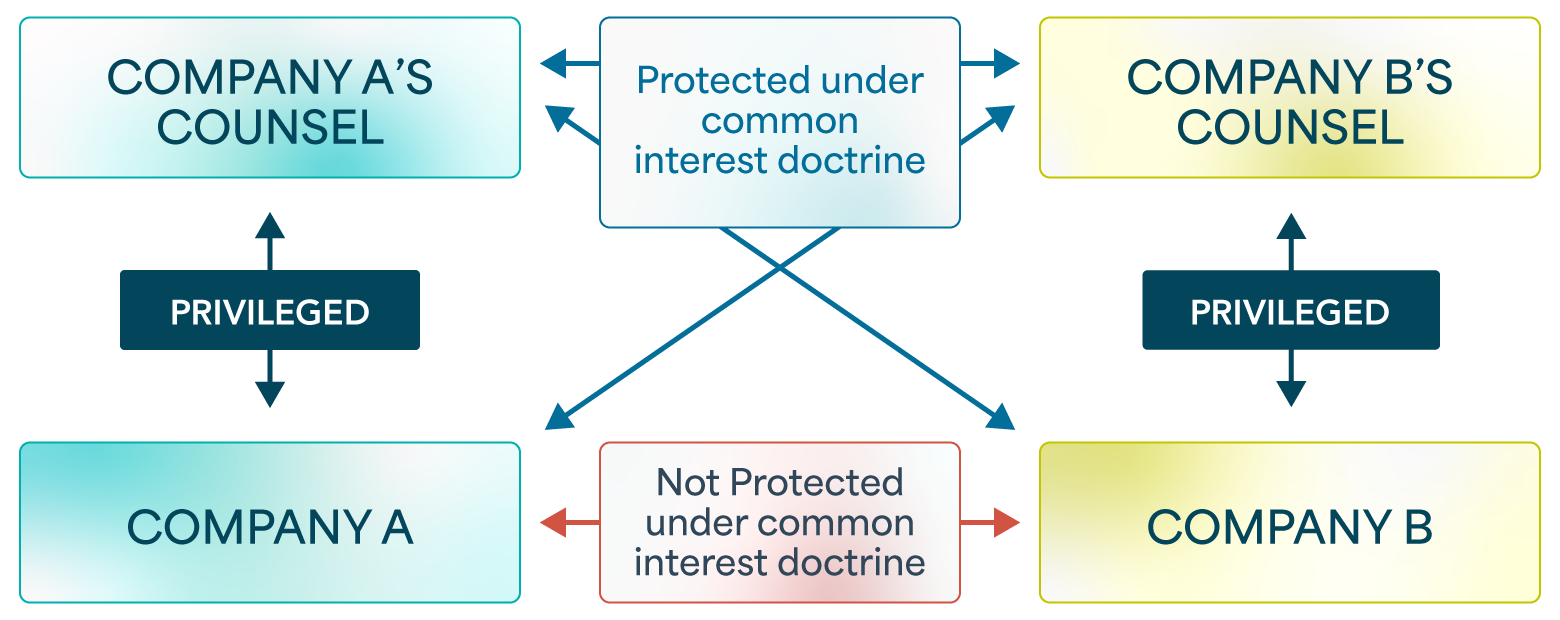
Do not assume privilege exists
Even if you believe a communication is privileged, write with the expectation that it could be reviewed by a court. Privilege does not necessarily extend automatically to subsidiaries or affiliates. Ensure formal retention and clear documentation when representing multiple entities or working with advisors. Additionally, the law governing privilege can vary significantly by jurisdiction; thus, it is important to seek the advice of counsel prior to any communications.
Labels help but don’t control
Mark emails or memos as “Attorney-Client Privileged” and “Confidential,” but remember: substance, not form, determines privilege. Where possible, clearly reference the legal advice sought or provided.
Be explicit in requests for legal advice
Directly address in-house or outside counsel, specify the legal issue, and avoid copying attorneys merely to shield a document.
Separate legal from business content
When communications blend legal and business matters, separate them or document the legal purpose clearly.
By proactively managing privilege, in-house counsel and executives can strengthen the protection of sensitive communications, preserve confidentiality, and reduce litigation risk.
Under Texas law, informal fiduciary relationships (which can theoretically arise from any personal or business relationship of special trust and confidence) are frequently claimed in litigation but almost never succeed. Two recent decisions illustrate the doctrine’s narrowing scope: in Pitts v. Rivas, the Texas Supreme Court rejected an informal fiduciary claim despite a decade-long personal friendship between an accountant and client, with a notable concurrence from Justice Huddle (joined by three justices) formally calling for the doctrine to be abandoned altogether. The Texas Business Court reached a similar conclusion in Tall v. Vanderhoef, dismissing an LLC minority member’s informal fiduciary claim because no special relationship of trust existed prior to and apart from the parties’ governing agreements. While the doctrine technically remains good law in Texas, courts continue to apply it with significant skepticism and practitioners should treat informal fiduciary claims as a high-risk, rarely successful avenue in business disputes
By the time a venture-backed company reaches its mid to late stages, its board is usually built out of overlapping interests. Directors are affiliated with the funds that led earlier rounds, a founder may hold a large voting block, and executives and investors alike see a steady stream of opportunities, some of which look a lot like the company’s own roadmap. Generally, Delaware corporate law treats these relationships not as misconduct but as a process question. Most recently, Delaware corporate law received meaningful codified updates to its conflicted transaction rules and the key in evaluating such transactions remains to ensure that process follows the most recent developments in the law.
Loyalty Sets the Baseline
Directors and officers of a Delaware corporation owe fiduciary duties of care and loyalty to the corporation. The duty of loyalty bars a fiduciary from using a position of trust to advance personal interests at the corporation’s expense, and it is the source of both bodies of law discussed here. A conflict of interest does not by itself make a transaction wrongful; what it changes is the standard of judicial review if the transaction is later challenged. A conflicted transaction that has not been properly cleansed risks review for entire fairness, the most demanding standard under Delaware law, while a transaction that satisfies the statutory safe harbors described below is insulated from fiduciary duty damages and equitable relief.
Conflicted Transactions Under Section 144
DGCL Section 144 gives boards a set of alternative cleansing paths. An act or transaction involving a conflicted director or officer qualifies for the safe harbor if any one of the following is true: the material facts of the interest and the transaction are disclosed or known to the board or a committee, and a majority of the disinterested directors approve it in good faith and without gross negligence; the transaction is approved or ratified by an informed, uncoerced, affirmative vote of a majority of the votes cast by the disinterested stockholders; or the transaction is fair to the corporation and its stockholders. However, if a majority of the board is conflicted, the director-approval route must run through a committee of at least two disinterested directors.
Controlling stockholder transactions have their own rules, and the statute defines who is a controller: a person who owns or controls a majority of the voting power, has the right to cause the election of a majority of the board, or holds at least one third of the voting power together with the power to exercise managerial authority over the corporation’s business and affairs. On a maturing cap table, that can describe a founder with high-vote stock or, in some circumstances, a lead investor, and stockholders acting together under an agreement or understanding can constitute a control group. A controlling stockholder transaction (other than a going private transaction) qualifies for the safe harbor if it is approved or recommended by a committee of at least two disinterested directors with express authority to negotiate and to reject the transaction, or if it is conditioned on and receives an informed, uncoerced majority-of-the-minority vote. Only a going private transaction requires both protections, a deliberate departure from prior case law, under which both were generally required for a controller transaction to earn business judgment review.
The statute also defines disinterestedness. A disinterested director is one who is not a party to the transaction and has no material interest in it or material relationship with a person who does, with materiality keyed to whether the director’s objectivity would reasonably be expected to be impaired. Directors of exchange-listed companies also receive a heightened presumption of disinterestedness if the board has determined they are independent under exchange rules, a provision that becomes relevant after an IPO.
The Corporate Opportunity Doctrine
The corporate opportunity doctrine answers a different loyalty question: when a business opportunity belongs to the corporation rather than to the fiduciary who learned of it. A director or officer of a Delaware corporation may not take an opportunity for personal benefit if the corporation is financially able to undertake it, the opportunity falls within the corporation’s line of business and would be of practical advantage to it, the corporation has an interest or reasonable expectancy in it, and taking it would place the fiduciary’s self-interest in conflict with the fiduciary’s duties. The Delaware Supreme Court has emphasized that the factors are weighed together and that no single factor is dispositive.
In the venture ecosystem, fund-affiliated directors see deal flow across an entire portfolio, and founders and executives routinely encounter ideas adjacent to the corporation’s business. A fiduciary who takes an opportunity that a court later decides belonged to the corporation faces disgorgement of the opportunity or its proceeds. However, a fiduciary who presents the opportunity to the board and obtains a rejection from disinterested directors gains the benefit of a safe harbor, mitigating the risk of an after-the-fact judicial determination that the opportunity was usurped. Presentation is not legally required, but it creates a clean contemporaneous record, and the rejection should be clearly documented in the minutes.
Advance Waivers Under Section 122(17)
Delaware also permits much of this to be resolved in advance. Section 122(17) of the DGCL authorizes a corporation to renounce, in its certificate of incorporation or by action of its board, any interest or expectancy in specified business opportunities or specified classes or categories of business opportunities, whether presented to the corporation or to one or more of its officers, directors, or stockholders. Waivers of this kind are common in venture capital investments, where a firm and its designees may hold positions and board seats across a sector, and it is recommended to build them into the certificate of incorporation at the time of investment (which is consistent with the NVCA model certificate of incorporation). Note that such a waiver addresses only the corporate opportunity doctrine, not confidentiality. Accordingly, funds holding positions in competing companies should maintain information screens and avoid seating the same designee on the boards of competitors.
That said, advance waivers may not be an absolute shield to all issues arising out of potential corporate opportunities. Although details are scant as of the time of writing, and we expect to publish more detailed analysis once information becomes available, in August of 2026 the U.S. Department of Justice has been investigating certain venture capital firms with partners serving on boards of competing companies, potentially raising antitrust concerns, separate from the corporate law concepts of corporate opportunity.
DO’S & DON’TS:
Board Process for Conflicted Transactions
DO: Surface conflicts early and choose the cleansing path before approval. Disclose all material facts about the fiduciary’s interest and involvement, obtain approval from a majority of the disinterested directors acting in good faith and without gross negligence, and use a committee of at least two board-determined disinterested directors whenever a majority of the board is conflicted.
DON’T: Treat a conflicted deal as either automatically prohibited or automatically safe because the terms feel like market. Without disinterested director approval, a qualifying disinterested stockholder vote, or provable fairness, the transaction and the fiduciaries remain exposed.
Controlling Stockholders and Investor Directors
DO: Test whether a founder, investor, or group acting together is a controlling stockholder or control group under Section 144(e) before structuring any related party transaction. For controller transactions, use a fully empowered committee of at least two disinterested directors or a conditioned majority-of-the-minority vote, and use both for a going private transaction.
DON’T: Assume control requires majority ownership; one third of the voting power plus managerial authority can suffice. And do not rely on a stockholder vote to cleanse a controller transaction unless the deal was conditioned on disinterested stockholder approval by its terms when submitted for the vote.
Corporate Opportunities
DO: Adopt a simple protocol: fiduciaries promptly disclose opportunities arguably within the corporation’s line of business, the board or its disinterested members decide whether the corporation will pursue them, and any rejection is documented in the minutes before the fiduciary proceeds.
DON’T: Let a director or officer pursue such an opportunity quietly, or with the corporation’s resources, personnel, or information. Informal assurances from management are not a substitute for board-level disclosure and a documented rejection.
Waivers and Information Hygiene
DO: Consider a Section 122(17) waiver in the certificate of incorporation tailored to fund-affiliated directors and stockholders, revisit its scope at each financing, and pair it with confidentiality screens where investors hold competing positions.
DON’T: Seat the same designee on the boards of competing portfolio companies or treat a waiver as permission to share the corporation’s confidential information.
A Delaware Court of Chancery post-trial opinion in Holzbaur v. Trolley Square Hospitality, LLC serves as a cautionary tale about imprecise LLC agreement drafting. The plaintiff believed he was a “cash contributing member” with irremovable status, but contradictory language in the agreement led the court to rely on extrinsic evidence (including emails, pre-formation conversations, and drafting history) to find he was actually a “sweat equity” member subject to removal at will. The case underscores that the flexibility of the LLC form carries drafting responsibility: internal inconsistencies open the door to costly litigation and invasive discovery, and ambiguities will be resolved based on the parties’ actual intent, not favorable contract language.